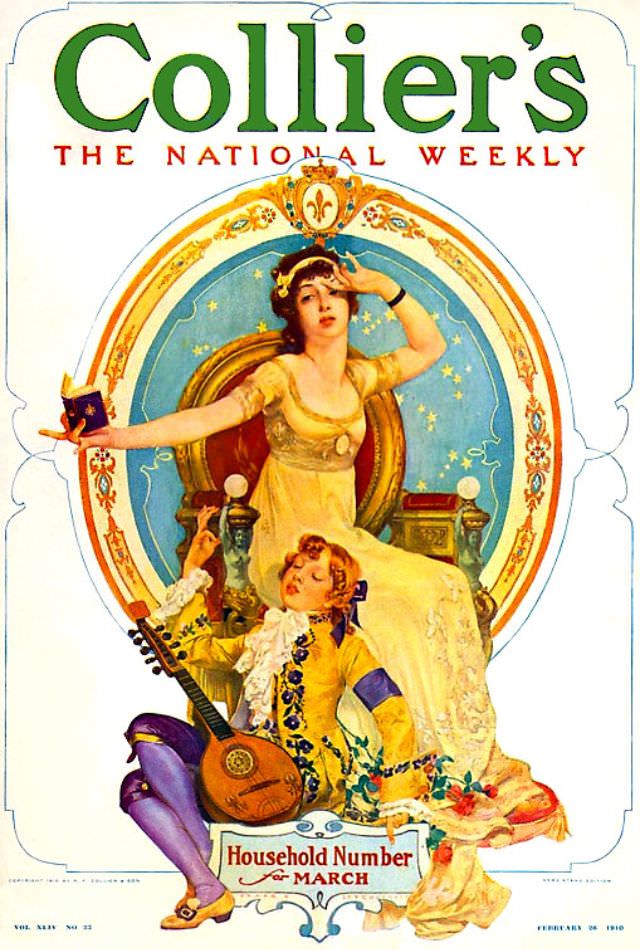
Collier’s, “The National Weekly,” greets the eye here with a richly colored cover that feels closer to a stage tableau than a mere magazine front. A woman in a flowing, pale gown poses within an ornate oval frame, one arm lifted as if shading her eyes from footlights, the other extended with a small object in hand. Below her, a costumed musician reclines with a mandolin, dressed in bright yellow with decorative trim and vivid purple stockings—an unmistakable nod to romantic, theatrical costume rather than everyday streetwear.
The design leans into early 20th-century illustration at its most confident: crisp lettering, decorative cartouche work, and a carefully balanced palette of green, red, gold, and sky blue. “Household Number for March” appears at the bottom, hinting at a seasonal, family-oriented issue even as the imagery plays with performance, music, and fantasy. Fine details—like the starry field behind the central figure and the gleam of the instrument—show how magazine art of the period sold mood and aspiration as much as content.
Dated February 24, 1910, this Collier’s cover is a reminder of how weekly magazines functioned as cultural fixtures, offering readers not just articles but a collectible visual experience. For historians, designers, and anyone interested in vintage magazine covers, it’s a striking example of the era’s commercial art—ornamental yet readable, dramatic yet inviting. As a piece of printed ephemera, it captures a moment when illustration, typography, and popular taste met on the newsstand in full color.