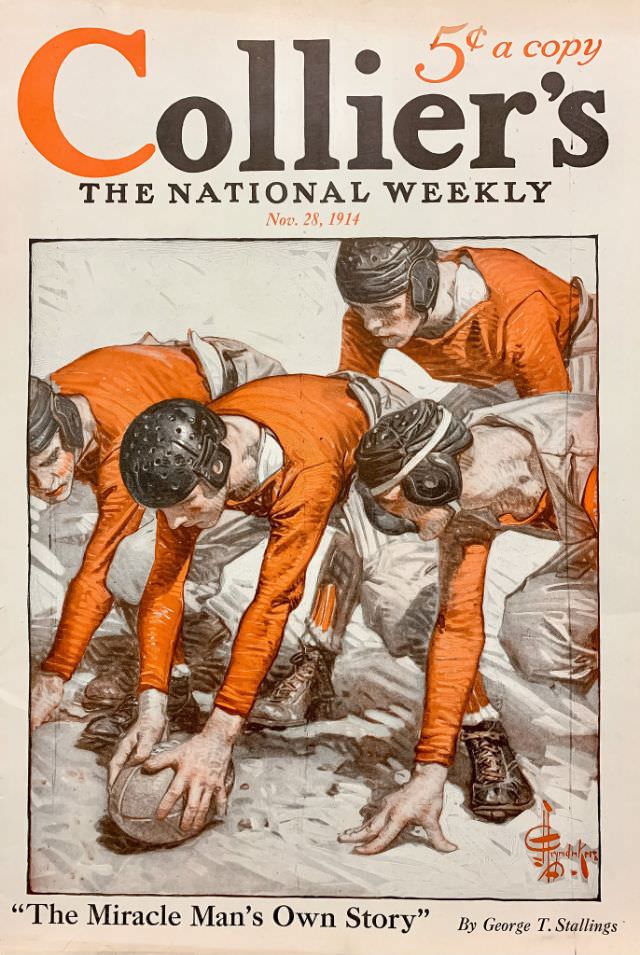
Bold typography crowns this Collier’s cover—“The National Weekly” priced at 5¢—anchoring a brisk slice of American magazine history dated Nov. 28, 1914. The design balances big, confident lettering with an illustration that pulls the eye downward into action, a classic early-20th-century approach meant to sell a story at a glance. For readers and collectors, it’s a vivid reminder of how mass-market periodicals blended journalism, fiction, and art into a single weekly ritual.
On the field, helmeted football players in orange and gray crouch low around the ball, hands tense and ready, their bodies packed tight in the pre-snap moment. The artist emphasizes movement through angled backs, bent knees, and overlapping forms, while the restricted palette keeps attention on the scrum and the gleam of protective gear. Even without a stadium backdrop, the scene conveys the grit and choreography of early football—more brawl than ballet, yet carefully staged for dramatic impact.
Beneath the illustration, the cover teases “The Miracle Man’s Own Story,” credited to George T. Stallings, tying the sports imagery to the magazine’s promised narrative punch. As an “Artworks” feature, this piece is especially useful for anyone researching Collier’s magazine covers, vintage illustration, early football iconography, or the marketing language of 1914 print culture. It’s a compact artifact that speaks to both the sporting imagination and the persuasive power of a well-drawn cover.