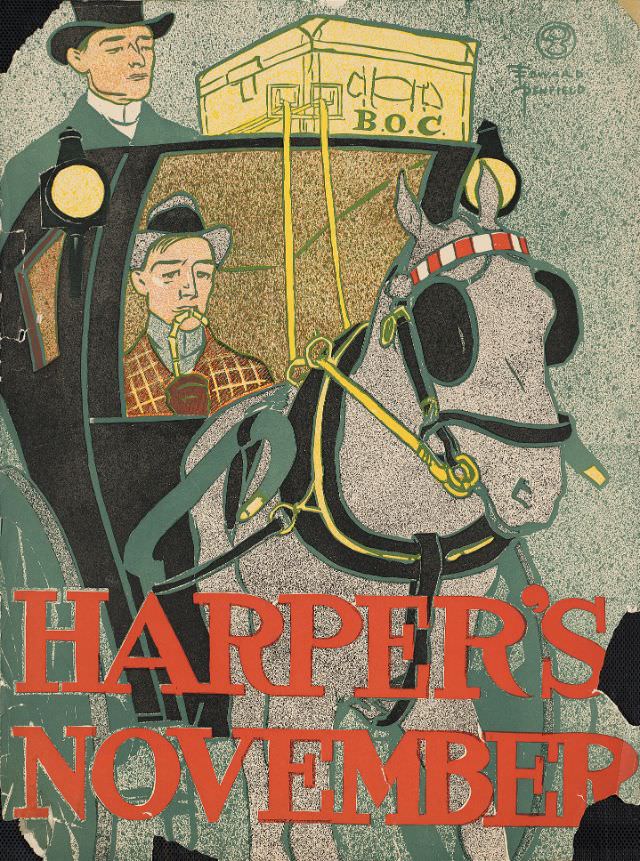
Bold lettering for “HARPER’S NOVEMBER” anchors this 1896 cover art, while a one-horse carriage presses forward in a striking, poster-like composition. The horse’s head dominates the foreground, its harness picked out in bright lines and a patterned browband, giving the scene a sense of motion and modern confidence. Behind that powerful profile, the carriage body and a small block of lettering (“B.O.C.”) hint at an urban, on-the-go world where transport and schedule mattered.
Two men ride together, rendered with crisp outlines and restrained facial detail that feels characteristic of late-19th-century illustration. One sits lower in the carriage, pipe in hand, wrapped in a checkered coat and a brimmed hat, suggesting comfort and routine; the other appears higher and more formal, his posture steady as if overseeing the journey. Their contrasting positions and expressions add narrative tension—passenger and driver, or companions with different roles—without needing a caption to make the story legible.
As a Harper’s magazine cover from November 1896, the piece works both as period advertising and as a snapshot of everyday mobility at the end of the century. The limited palette, textured shading, and strong typography create a memorable graphic design that reads well on modern screens while still carrying the atmosphere of its original print era. For collectors and historians of magazine cover art, horse-drawn carriage imagery, and Victorian-era visual culture, this image offers an engaging doorway into how travel, leisure, and identity were sold to readers.