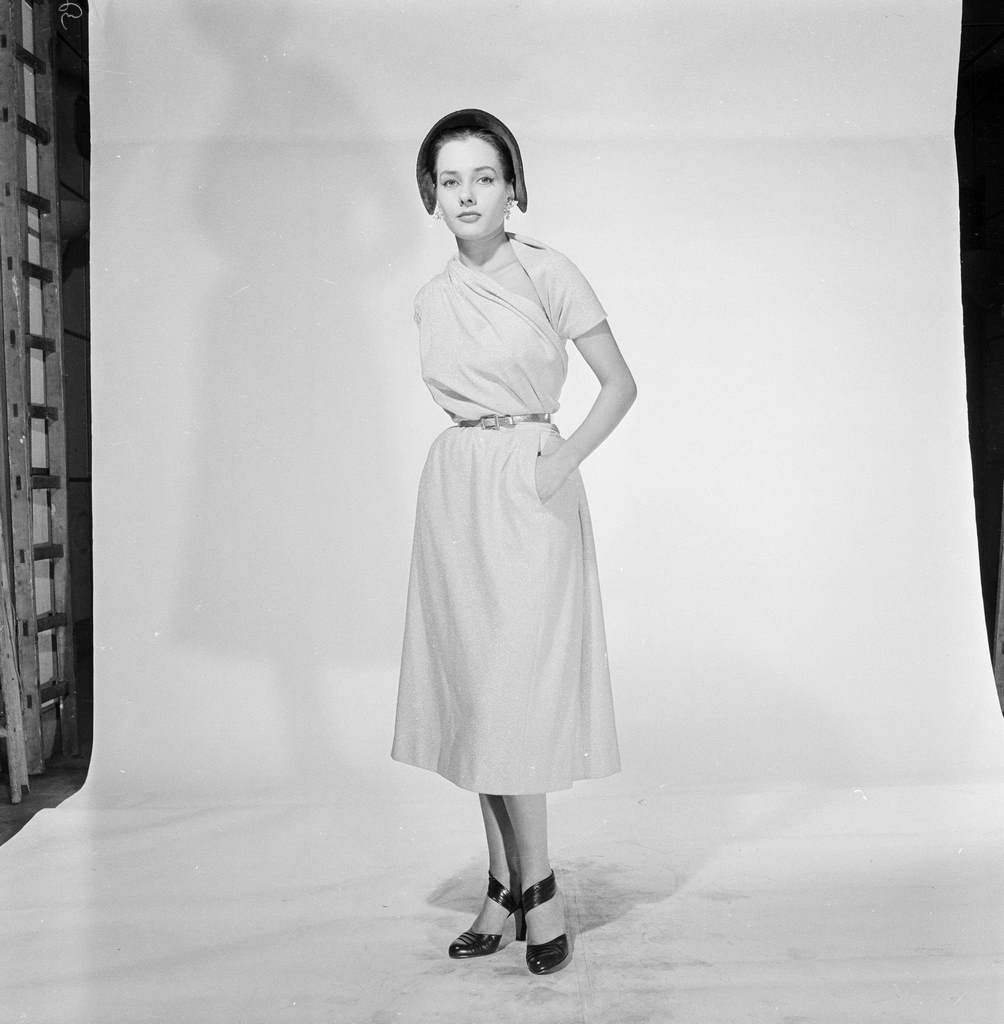
Poised against a seamless studio backdrop, a runway model stands in a quiet moment of mid-century elegance, her gaze slightly averted as if caught between fitting room and spotlight. The clean, controlled lighting and uncluttered setting draw attention to silhouette and stance, while the visible edges of the set hint at the practical machinery behind fashion photography. In the context of the “Couturiers Associés” fashion collection of 1951, the composition reflects the era’s effort to present couture as modern, disciplined, and internationally legible.
Her outfit balances structure with ease: a softly draped bodice with an asymmetrical neckline, cinched by a slim belt to define the waist, then falling into a calf-length skirt that moves away from the body with restrained volume. A rounded hat frames the face in a compact, sculptural way, and dark, crisscrossed shoes add graphic contrast at the hemline. The hand tucked into a pocket—casual but deliberate—signals a postwar shift toward wearable sophistication, where daywear could still carry the authority of high fashion.
Fashion history often lives in details like these, and this image reads as both style document and cultural artifact, linking couture technique to everyday aspiration. The title situates it within the collaborative world of French fashion promotion, when designers and associations worked to reaffirm prestige through carefully staged collections. For anyone researching 1950s couture, Jacques Fath–era design, or the broader story of fashion and culture, the photograph offers a crisp reference point: elegance distilled into line, fabric, and a single, self-possessed pose.