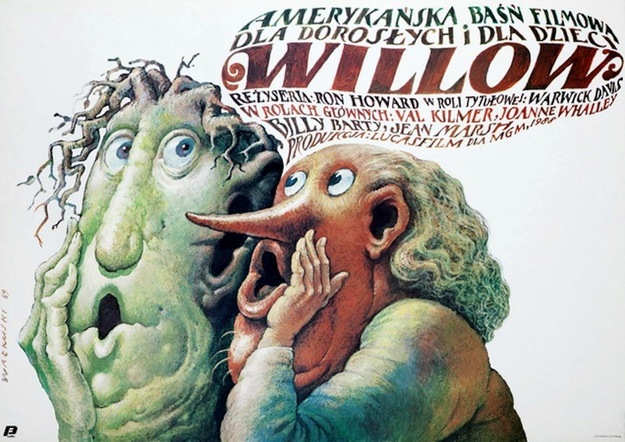
A bold, hand-lettered “WILLOW” crowns this 1989 cover art by Wiesław Wałkuski, framed by Polish text that reads like a theatrical prologue. The typography itself becomes part of the drama—curving, crowded, and emphatic—suggesting a fantasy tale pitched to more than one audience, as the surrounding wording hints at a story “for adults and for children.” Even before you study the figures, the design signals the era’s distinctive poster culture: expressive lettering, painterly surfaces, and a willingness to lean into the surreal.
At the center, two faces dominate the composition, pressed close in an uneasy exchange. A long-nosed, human-like figure cups a hand to the mouth as if whispering a secret, while a larger, greenish head—pocked and hollowed with dark openings—stares forward with a stunned, masklike stillness. Wałkuski’s brushwork favors texture over polish: mottled skin tones, tangled hair, and exaggerated features that push the scene into grotesque comedy, where humor and threat sit side by side.
Rather than illustrating a straightforward moment from the story, the artwork sells a mood: rumor, enchantment, and the suspicion that something powerful is being said just out of earshot. The close-up framing turns fantasy into psychology, making the viewer complicit in the whisper and the reaction. For anyone searching for Willow poster art, Wiesław Wałkuski cover art, or Polish film poster design from the late 1980s, this piece stands as a striking example of how illustration can transform familiar fantasy into something stranger and more memorable.