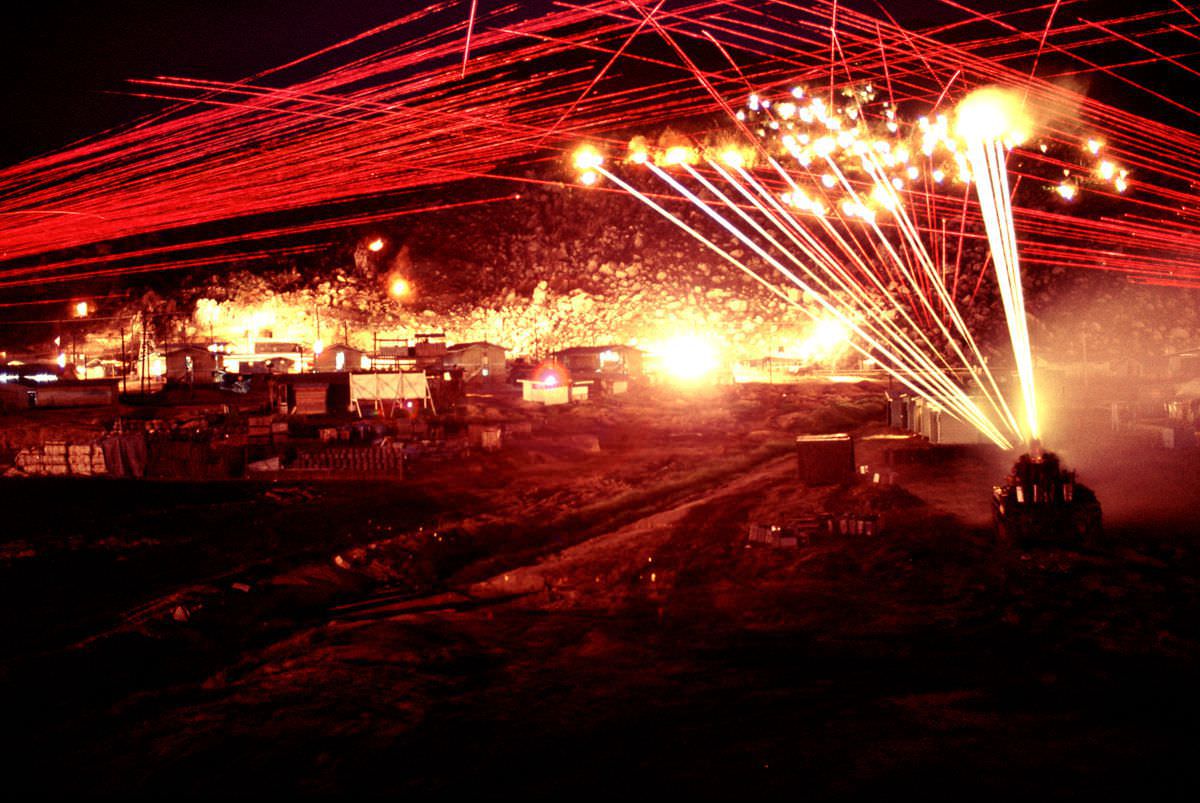
Streaks of tracer fire carve bright arcs across a humid night sky, turning the horizon into a web of red lines and white-hot bursts. Below the light show, the outlines of a defended position—low buildings, earthworks, and rough tracks—sit in harsh, intermittent glare as automatic weapons rake outward. The long exposure effect emphasizes motion and volume, making the firefight feel almost continuous rather than a series of separate flashes.
At the heart of the scene is the combined arms rhythm suggested by the title: an M42 Duster reopening with its 40mm autocannons while M60 machine guns and .50-caliber fire continue without pause. In Vietnam War imagery, that mix often signaled perimeter defense at night, when visibility was limited and suppression mattered as much as precision. The vehicles and emplacements become silhouettes, but the ammunition’s glowing path reveals the geometry of the defense—fields of fire, overlapping lanes, and the frantic urgency of contact after dark.
Taken as a historical document, the photograph speaks to the industrial scale of small-unit combat in the Vietnam War and the distinctive visual signature of tracer ammunition over fortified ground. It also highlights how technology shaped the battlefield experience: heavy automatic fire, rapid response, and an attempt to dominate darkness with light and volume. For readers exploring Vietnam War history, M42 Duster operations, and night perimeter firefights, the image offers a stark, unforgettable window into the intensity of that era.