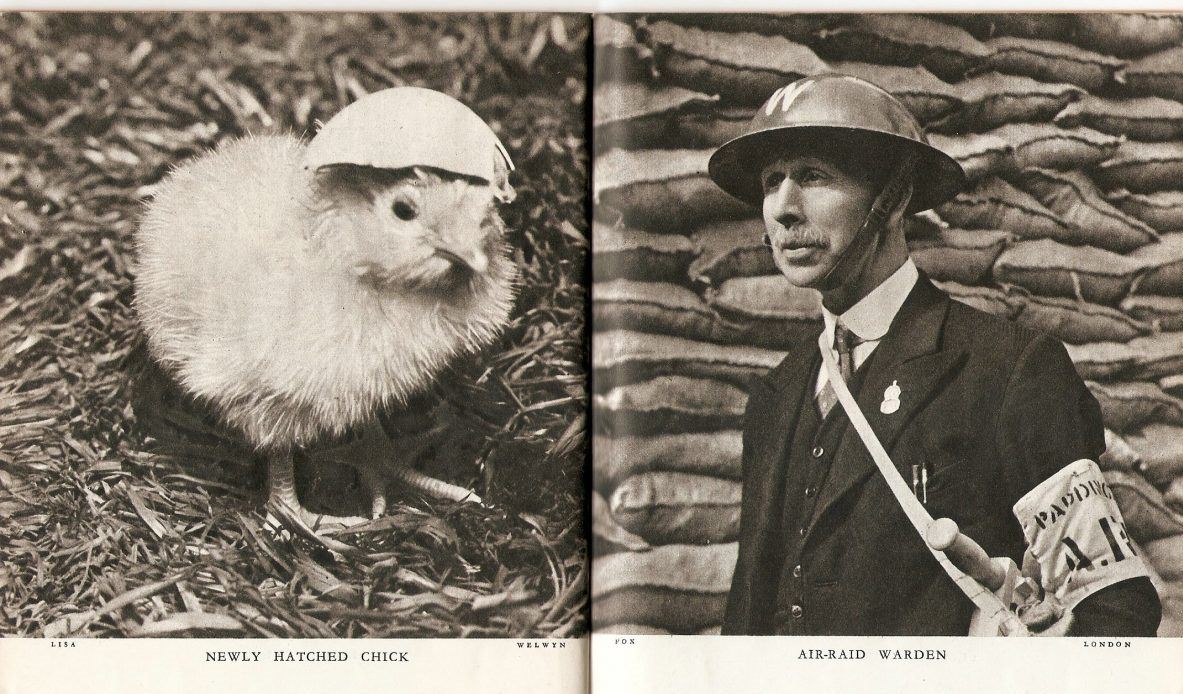
A tiny newly hatched chick stands on straw with half its shell still perched like a cap, an instant of barnyard comedy rendered in crisp monochrome. The framing lingers on soft down, spindly legs, and the wide, uncertain gaze of a creature only moments into its new life. It’s the kind of small, intimate detail that makes historical photography feel close enough to touch.
Across the spread, an air-raid warden appears in sharp contrast: uniformed, moustached, and helmeted, with a bold “W” on the crown and an armband marked “A.R.P.” A whistle hangs ready at his chest, and a wall of sandbags rises behind him, turning the background into a defensive landscape of stacked fabric and vigilance. The mood shifts from rural warmth to civic duty, hinting at the routines and anxieties of wartime home-front life without needing a single explosion in frame.
Placed side by side, the chick and the warden create a playful but telling juxtaposition—fragility and protection, innocence and responsibility, everyday humor and grim preparedness. For readers searching for a WWII-era air raid warden photo or an A.R.P. armband image, this pairing offers both clear visual cues and a memorable narrative twist. The result is “funny” in the best historical sense: a reminder that even during periods of danger, ordinary life kept hatching, marching, and making room for the odd, human moment.