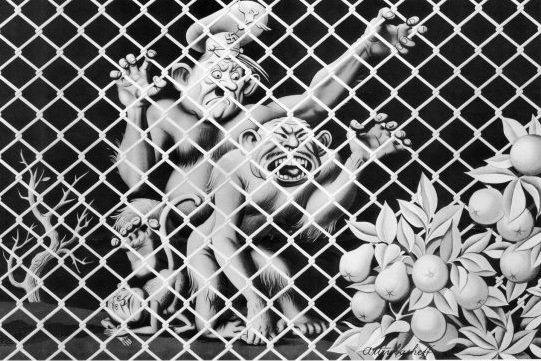
Barbed satire leaps off the page in Boris Artzybasheff’s WWII-era anti-Nazi illustrations, where snarling caricature and claustrophobic framing turn propaganda into something unsettlingly alive. In this featured artwork, a chain-link pattern dominates the foreground like a prison wall, pressing the viewer against the scene while grotesque, beastlike figures strain and claw from behind it. The effect is immediate and theatrical—an oppressive sense of confinement paired with raw menace, rendered with the sharp control of a master illustrator.
Artzybasheff’s strength lies in how he distills ideology into visual metaphor, using distortion, exaggeration, and symbolic detail to communicate fear, brutality, and moral collapse. The figures’ twisted faces and aggressive gestures read as more than monsters; they suggest a system that consumes humanity, reduced to a snarling spectacle. Even the composition’s right side—where rounded fruit and leaves appear in stark contrast—adds tension, hinting at what’s threatened or defended: ordinary life, nourishment, and stability placed beside violence.
Readers drawn to WWII art, political illustration, and historical propaganda will find these anti-Nazi artworks both visually striking and historically resonant. They reflect a moment when illustrators helped shape public understanding of the war, fighting with ink and imagination as much as with weapons. Explore the creative force of Boris Artzybasheff’s wartime imagery and see how a single illustration can convey dread, defiance, and the urgency of resistance.