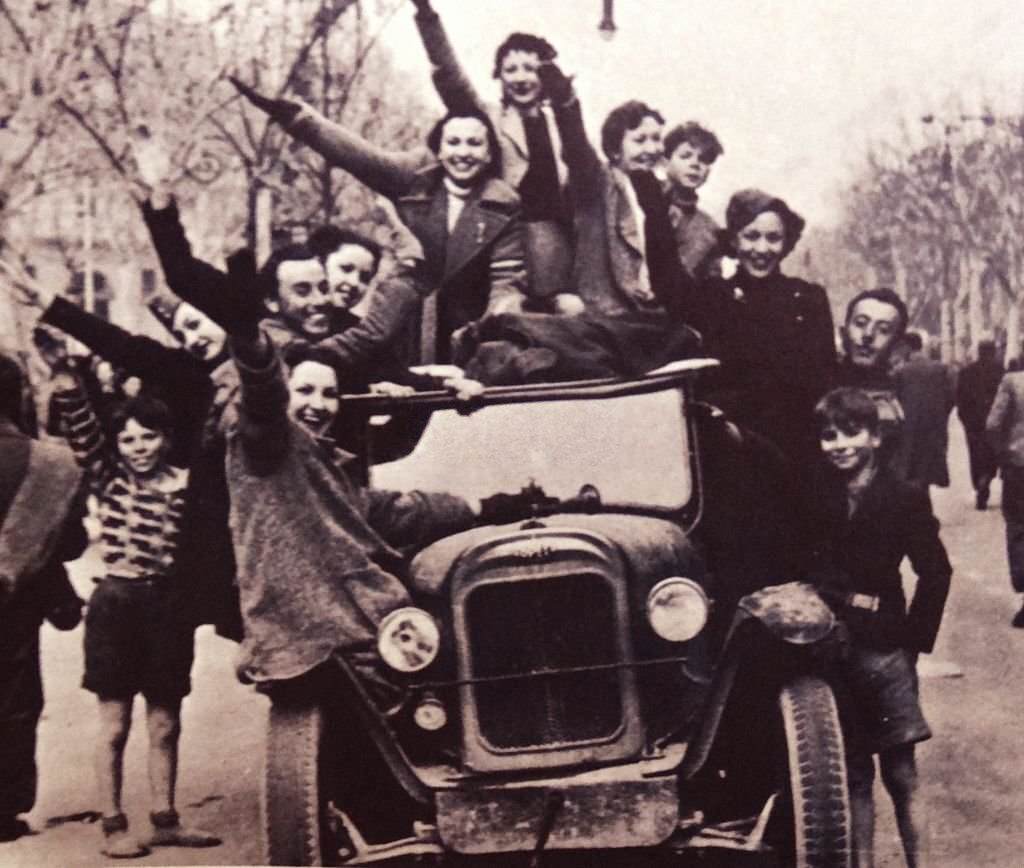
Laughter and raised arms spill out of an open car as a mixed crowd—women, men, and children—press close to the lens, turning a city street into a stage for triumph. Faces beam with the kind of public exhilaration that comes when a battle’s outcome feels settled, if only for the moment, and the vehicle itself becomes a moving platform for celebration. Bare winter trees and blurred buildings recede behind them, emphasizing the human energy in the foreground.
Set in Barcelona on January 27, 1939, the scene belongs to the final, devastating chapter of the Spanish Civil War, when the Nationalist advance transformed everyday avenues into corridors of victory. What reads at first like spontaneous merriment also carries the unmistakable weight of a turning point—one side rejoicing while another faces flight, reprisals, and silence. The photo freezes that collision between civic normalcy and political rupture, a hallmark of civil wars where neighbors can become opposing camps overnight.
Details invite a closer look for readers tracing wartime Barcelona: the period clothing, the compact automobile packed beyond comfort, and the candid composition that suggests a quick moment seized rather than a carefully arranged propaganda tableau. Yet the smiles do not simplify the story; they complicate it, reminding us how conflict produces competing memories within the same streets and the same families. As a historical document, it offers both immediacy and unease—an SEO-relevant window into Barcelona 1939, Nationalist celebration, and the lived texture of the Spanish Civil War’s endgame.