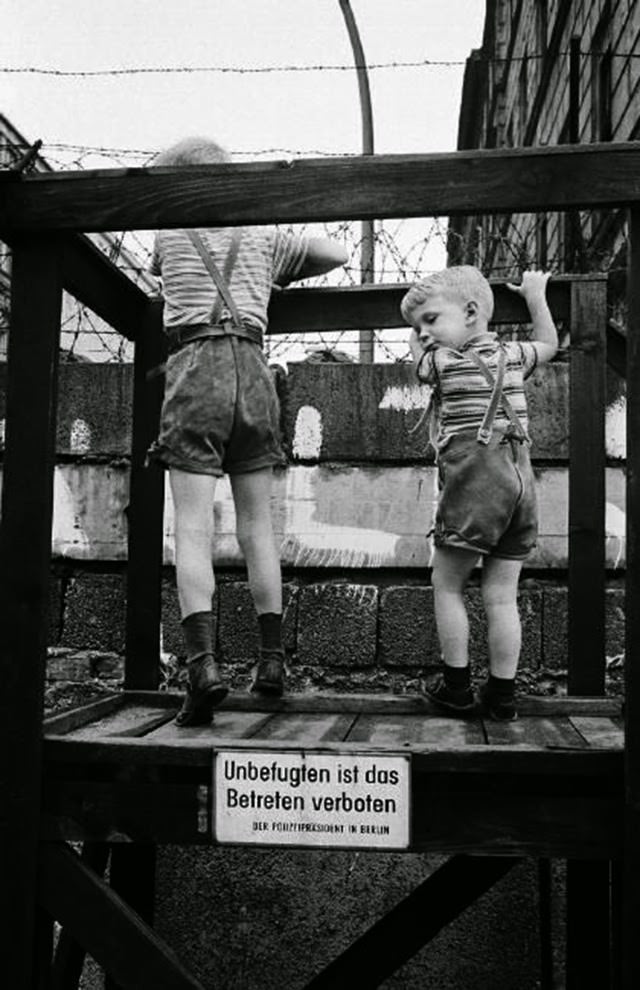
Perched on a rough wooden viewing platform, two boys in leather shorts and suspenders lean into the rail, their small hands gripping the timber as they try to see past the barrier. Coils of barbed wire slice across the sky above them, while the Wall’s stained concrete and stacked blocks form a hard horizon at child height. The contrast is striking: ordinary childhood curiosity framed by one of the Cold War’s most intimidating frontiers.
On the western side of the Berlin Wall, such platforms turned a fortified border into a public vantage point, a place where onlookers could stare into the closed-off strip beyond. A German warning sign—“Unbefugten ist das Betreten verboten” (“Unauthorized entry is forbidden”)—hangs below, a reminder that even observation was regulated in a landscape built for control. The boys’ casual posture, one craning forward and the other glancing down, underscores how quickly extraordinary politics can become part of everyday life.
Stories labeled “Civil Wars” often evoke distant battlefields, yet this scene suggests a quieter kind of conflict: a city divided, families separated, and a generation growing up with concrete, wire, and watchfulness as background scenery. As a historical photo of the Berlin Wall’s western side, it captures the uneasy overlap of innocence and intimidation, where a simple act of looking becomes a lesson in boundaries. For readers searching Berlin Wall history, Cold War photography, or daily life in divided Berlin, the image offers a vivid, human-scaled entry point into the era’s tension.