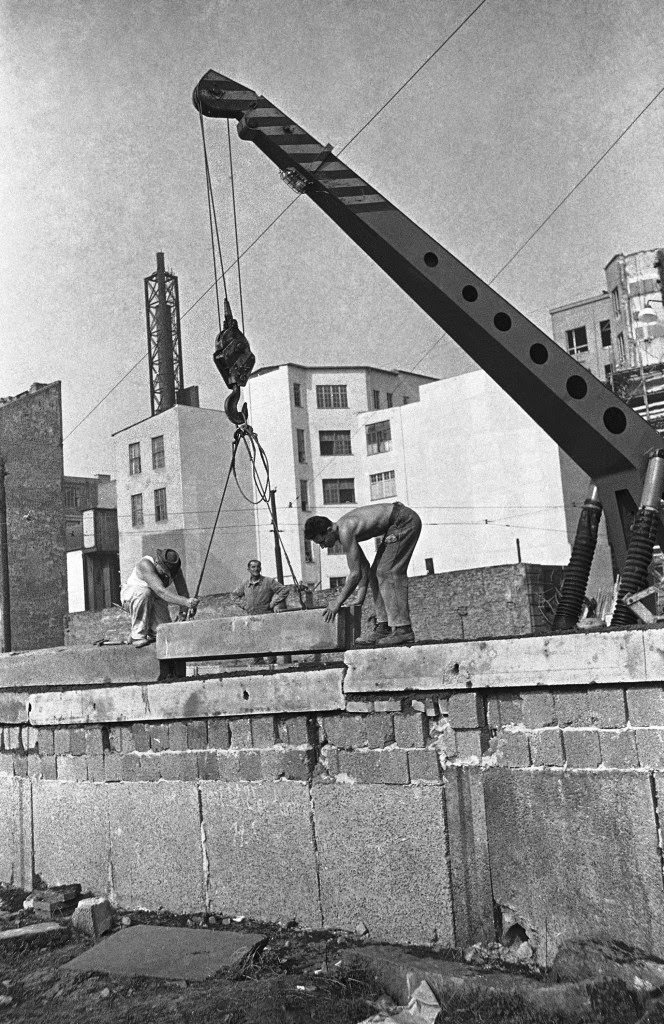
Steel cables hang taut from a crane boom as workers steady a heavy panel atop a rough barrier, turning a street edge into a fortified line. The scene at Zimmerstrasse near the Friedrichstrasse crossing point conveys the improvisation and urgency of early Berlin Wall construction, when concrete, glass, and labor reshaped everyday urban space into a border. Behind the men, apartment blocks and scarred building fronts stand as silent witnesses to a city being re-engineered in plain view.
What feels most striking is the combination of construction-site routine and political rupture: hands guiding a slab into place, a hook swinging overhead, rubble and broken ground underfoot. Concrete segments and stacked blocks create a layered wall that is still in the process of becoming permanent, suggesting an escalating effort to seal gaps and deny passage. In the background, the familiar geometry of windows and facades contrasts with the unnatural cut the border imposes on streets, courtyards, and sightlines.
Taken in late September 1961, the photograph situates the Cold War not in conference rooms but in the physical mechanics of separation, where a crane’s lift becomes an instrument of policy. Viewers searching for East Berlin, West Berlin, Berlin border history, or early Berlin Wall images will recognize the grim clarity of this moment: a divided city translated into concrete and glass, block by block. The title’s mention of Zimmerstrasse and Friedrichstrasse anchors the image in a well-known crossing area, underscoring how quickly ordinary neighborhoods became the front line of a new European boundary.