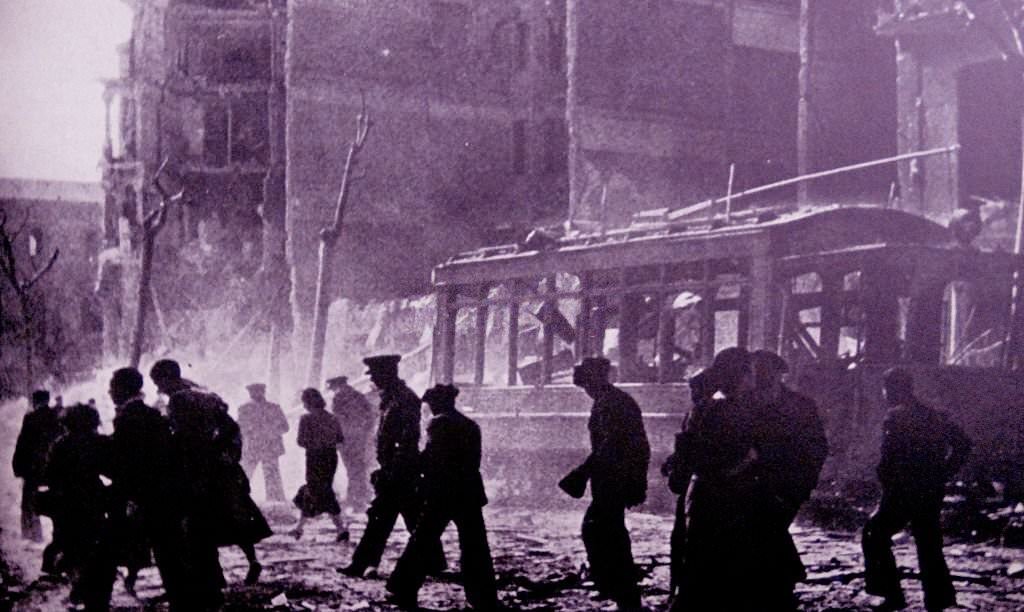
Smoke and dust hang low over a shattered street as figures pick their way across rubble, their silhouettes cut against the hulking façades of damaged buildings. A wrecked tramcar sits amid the destruction, its frame exposed and its windows blown out, suggesting how quickly everyday city life could be turned into a scene of emergency. In the murky background, upper stories appear torn open, with walls blackened and interiors left bare to the air.
The title points to the Spanish Civil War and a nationalist air raid, and the photograph reads like a brief, unfiltered report from the aftermath: debris carpeting the roadway, haze from fires or collapsed masonry, and civilians and uniformed men moving through the devastation. Streetcar lines and urban architecture anchor the setting in a Spanish city without naming it, emphasizing that aerial bombing was no longer confined to front lines. What stands out is the mix of motion and shock—people walking, searching, regrouping—while the city around them looks suddenly unrecognizable.
Damage like this became part of a wider story of modern warfare, where air power targeted infrastructure and morale as much as military positions. For readers exploring Spanish Civil War history, the image offers an immediate sense of scale and vulnerability: public transport wrecked, housing ripped apart, and a community forced into the street under a clouded sky. As a historical photo, it preserves not just destruction, but the human presence within it—the urgent, quiet work of enduring an air raid’s aftermath.