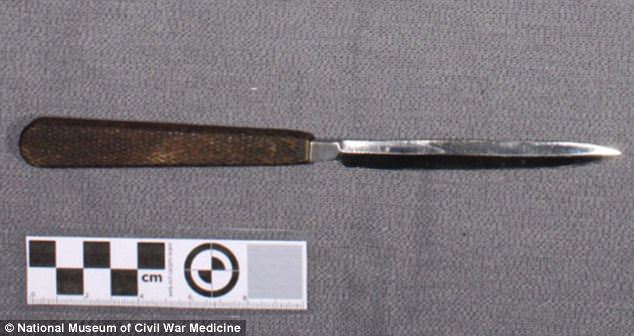
Laid out against a plain backdrop, a long, single-edged amputation knife rests beside a measurement scale that emphasizes its working length and slender profile. The dark, worn handle contrasts with the reflective steel blade, a pairing that hints at repeated use and careful maintenance. Credited to the National Museum of Civil War Medicine, the photo carries the quiet authority of a cataloged artifact rather than a dramatic scene.
Designed for speed and control, this type of surgical knife was used to slice through skin and muscle during circular amputations, creating a clean, continuous cut that surgeons could follow around a limb. The blade’s narrow taper and sharp edge speak to a tool made for decisive movement, while the utilitarian construction reflects the practical realities of wartime medicine. In the context of Civil Wars-era care, instruments like this belonged to a world where infection, shock, and limited anesthesia shaped every choice.
For readers exploring Civil War medical history, the knife offers a stark entry point into the lived experience of field hospitals and emergency surgery. It also serves as a reminder that behind every surgical instrument lies a story of injury, improvisation, and the evolving craft of military medicine. As a historical photo for a WordPress post, it supports searches for amputation tools, antique surgical instruments, and Civil War medicine artifacts while keeping the focus on the object’s material truth.