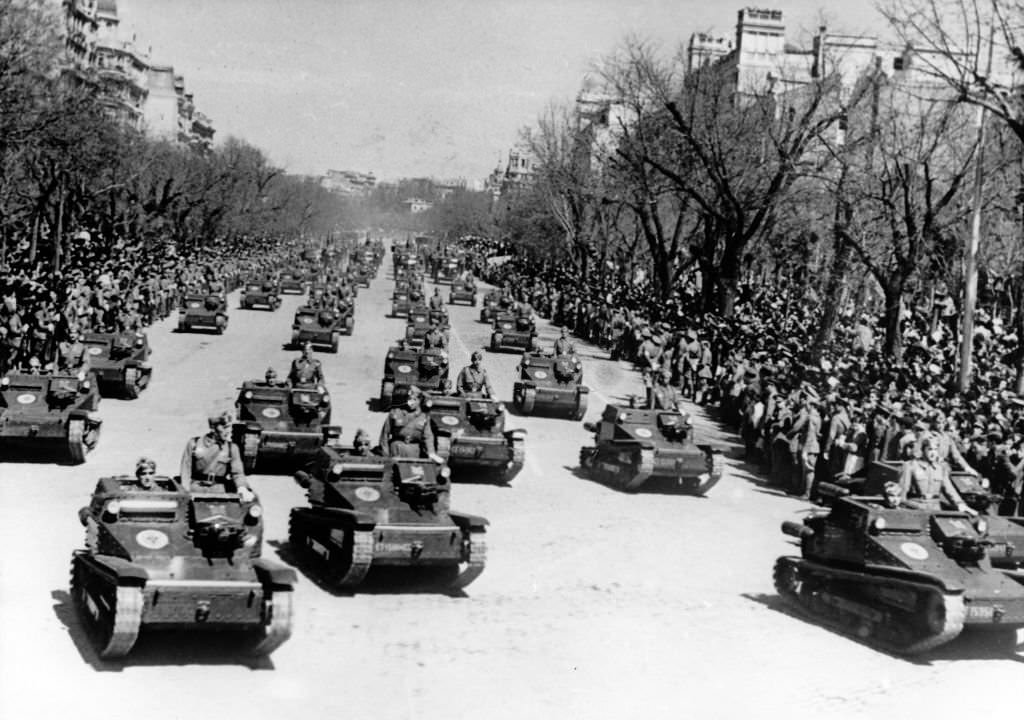
Down a broad Madrid boulevard, rows of armored vehicles roll forward in tight formation, their crews visible above open hatches as dense crowds press in behind the curb. Leafless trees frame the avenue and mid-rise buildings recede into the distance, turning the city itself into a stage for disciplined movement and spectacle. The sheer repetition of machines and the symmetry of the procession emphasize power, order, and readiness—exactly the kind of visual rhythm propaganda favors.
According to the title, this Nazi propaganda picture presents the march of Spanish troops in front of Spanish dictator Francisco Franco in Madrid, Spain, on 01 April 1943. Whether the onlookers came out of loyalty, curiosity, or obligation, the scene is composed to suggest unanimity: soldiers and vehicles dominate the center while civilians become a continuous border along both sides. In the context of Spain after the Civil War, such parades served to broadcast stability and authority while masking the strains and divisions that lingered beneath public ceremony.
For readers searching for World War II-era Madrid, Francoist Spain, or wartime propaganda imagery, the photograph offers a vivid example of how regimes curated the appearance of strength through militarized pageantry. The camera’s elevated viewpoint and deep perspective draw the eye toward the vanishing point, amplifying the impression of an endless column and an organized state in command of its streets. Seen today, it is both a record of a specific public display and a reminder that propaganda is as much about framing and choreography as it is about events.