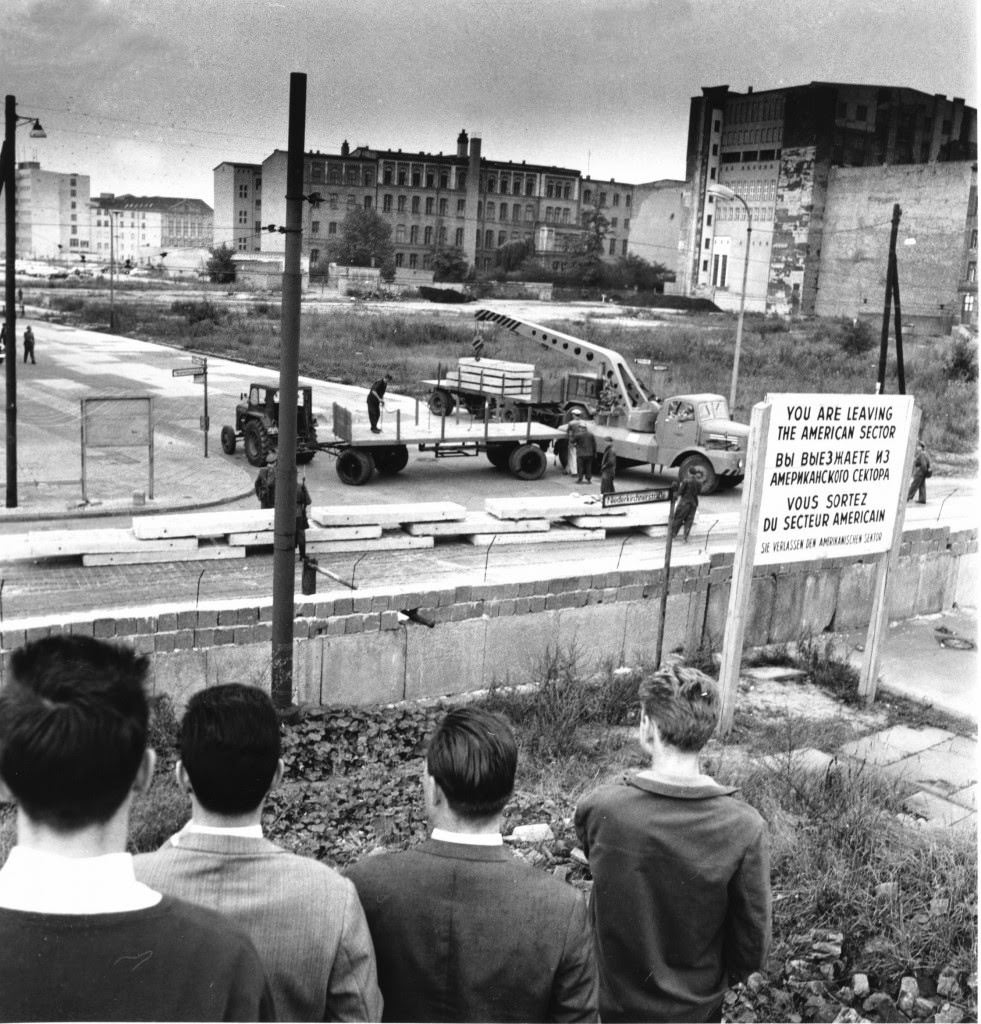
Four West Berliners stand with their backs to the lens, watching work crews across the boundary handle stacks of prefabricated concrete plates at Wilhelmstraße in Berlin on September 12, 1961. Beyond a low line of blocks and rough ground, a crane truck and flatbed sit in an open scar of city landscape, framed by damaged facades and empty lots that still speak to the unfinished repairs of the postwar years. The scene is quiet on the surface—no shouting, no running—yet every body posture in the foreground suggests attention, unease, and the weight of what is being built.
A large sign at the right edge delivers the border’s blunt bureaucracy in multiple languages: “YOU ARE LEAVING THE AMERICAN SECTOR,” a reminder that Cold War Berlin was divided not only by ideology but by checkpoints, jurisdiction, and daily rules. The concrete slabs being unloaded are not abstract symbols; they are materials becoming policy, turning streets into barriers and neighborhoods into frontiers. In a single frame, the Berlin Wall’s early reinforcement feels less like a distant geopolitical event and more like construction work carried out within sight of ordinary residents.
Seen today, this historical photo reads as a stark study in separation—people close enough to observe one another, yet forced into different worlds by a growing border. The vacant ground between buildings, the makeshift fortifications, and the careful labor around heavy plates capture how quickly an urban space can be reshaped into a controlled zone. For anyone searching Cold War history, Berlin Wall construction, or life in divided Berlin, this image offers a grounded, human-scale view of a city being partitioned in real time.