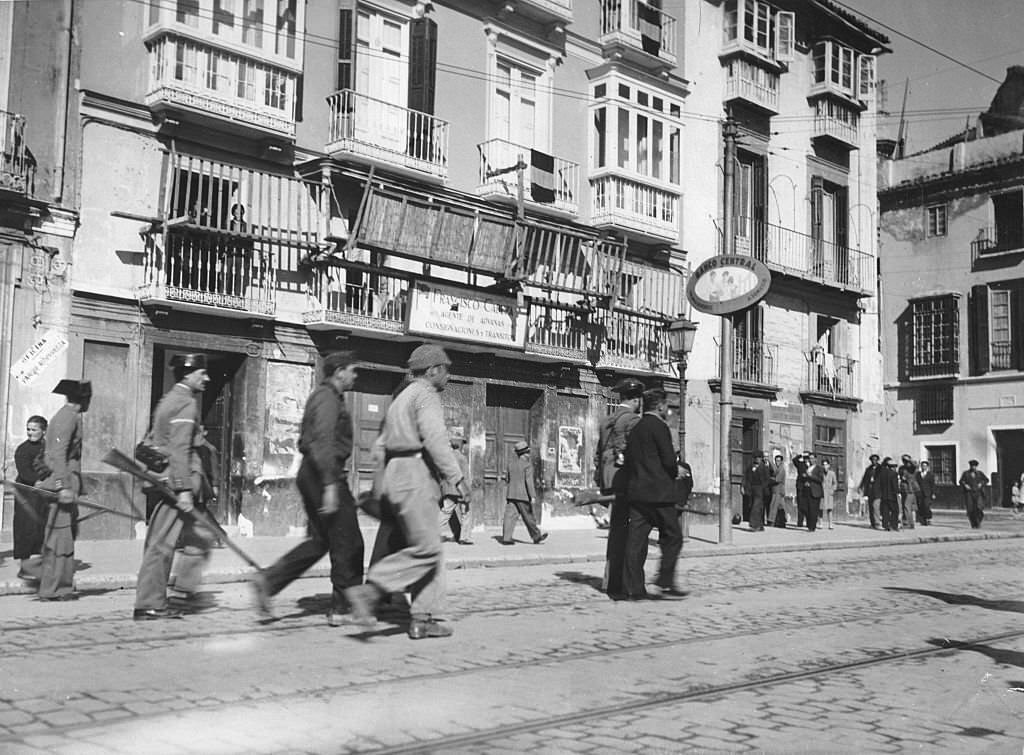
Along a broad, sunlit street lined with tall apartment façades and enclosed balconies, a small column of detainees is marched past shuttered storefronts and pasted notices. Armed escorts flank the group, their rifles and uniforms cutting stark silhouettes against the pale walls, while a handful of civilians linger at the edges, watching from doorways and the open square. Tram tracks and cobblestones run across the foreground, grounding the scene in everyday city life even as that normal rhythm is interrupted.
The title places this moment in the Spanish Civil War, when Nationalist forces captured a city on 7 February 1937 and Republican supporters were led away in the aftermath. What stands out is the contrast between movement and stillness: the prisoners and guards stride across the frame, while onlookers remain scattered and cautious, as if unsure where safety lies. The architecture—dense, multi-storey, and urban—suggests how rapidly the conflict could turn familiar streets into corridors of control.
For readers exploring Spanish Civil War history, this photograph offers a sober glimpse into occupation, detention, and the immediate consequences of a change in power. It speaks not only to battlefield outcomes but to what followed them: public processions, enforced order, and the silent recalibration of a community under new authority. As a historical image, it invites closer attention to the small details—posters on the walls, clustered spectators, the geometry of the street—each a trace of a city absorbing the shock of capture.