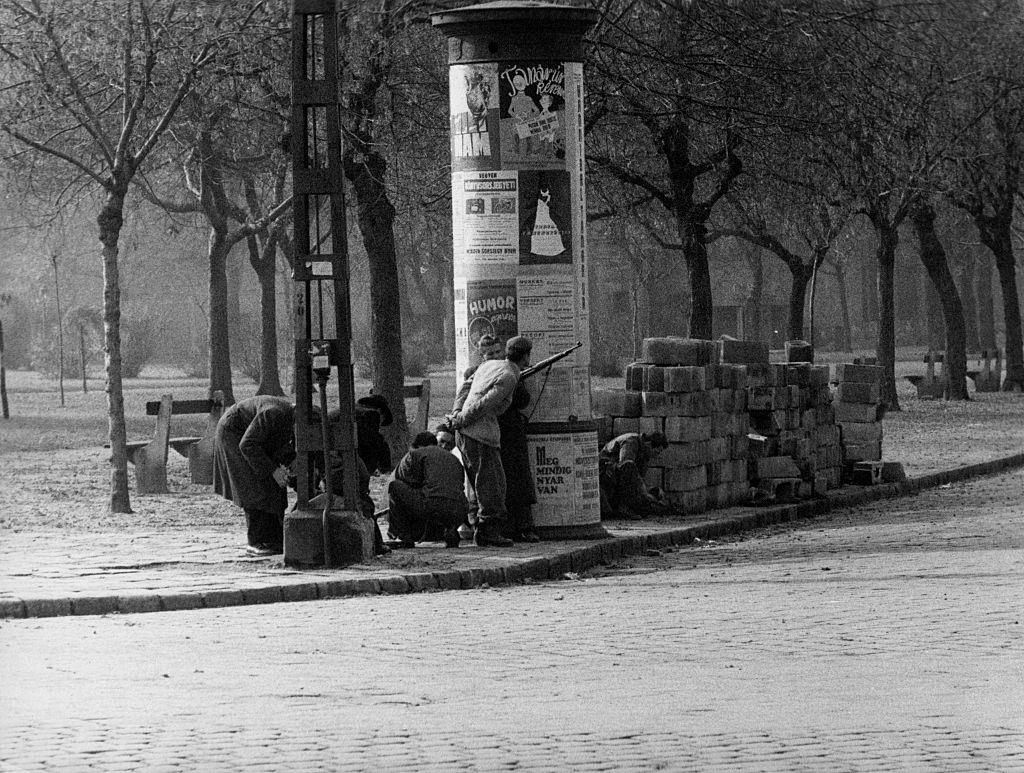
Along a quiet Budapest street in November 1956, a handful of men press themselves into the hard geometry of a corner, using a poster-covered advertising column and a low wall of stacked masonry as makeshift protection. One figure stands with a rifle angled toward the open roadway while others crouch close to the curb, their bodies turned inward as if listening for the next burst of movement. Bare trees line the background, and the wide, cobbled pavement feels unusually exposed—an everyday city scene transformed into a battlefield by the Hungarian Revolution.
The details pull you into the tense improvisation of urban revolt: thin cover, quick decisions, and the uneasy pause between action and response. Notices and graphics layered on the column hint at ordinary civic life continuing in paper and ink even as armed resistance reshapes the same public space. The composition emphasizes vulnerability—open street in the foreground, shelter clustered tightly at the edge—capturing how street corners became vital positions during clashes against Soviet control.
Seen today, this historical photo reads as both documentation and warning, a snapshot of civil conflict where anonymity is part of the story. It offers a grounded look at the 1956 Hungarian uprising in Budapest, showing not leaders or speeches but the tense work of waiting, guarding, and surviving in the street. For readers exploring Cold War history, the Hungarian Revolution, or the human scale of civil wars, the image holds the weight of a city caught between hope and coercion.