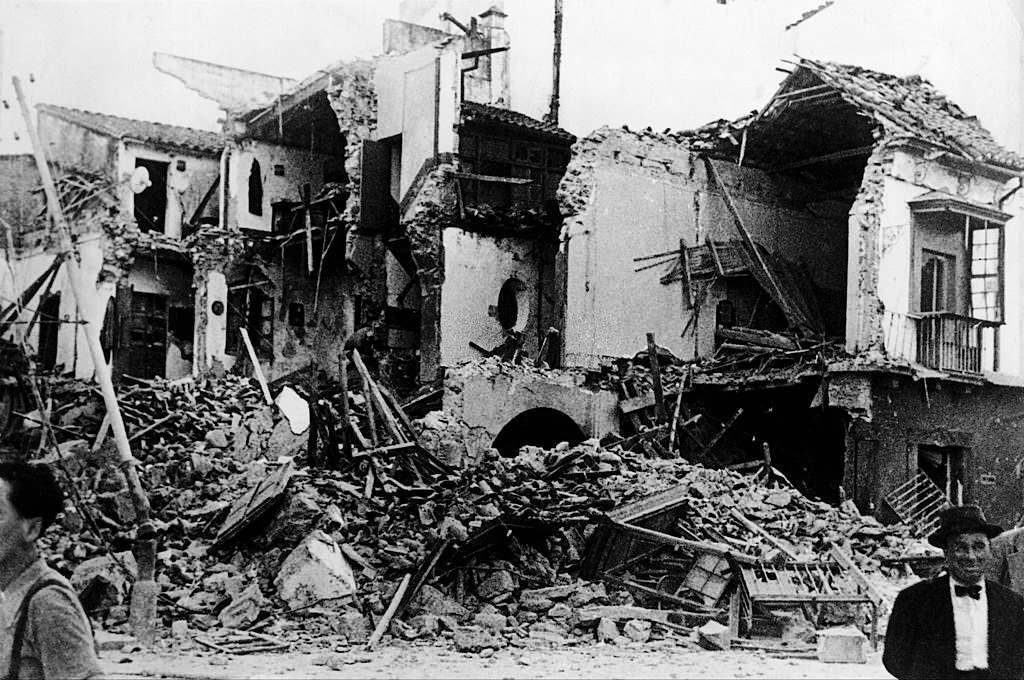
Rubble fills the foreground where a row of homes once stood, their walls split open to reveal shattered interiors and dangling beams. In the center, broken arches and jagged masonry frame a street turned into a field of debris, while the remaining sections of roofline cling to the ruins. The title places this destruction in Algeciras during the Spanish Civil War in 1936, and the scene conveys the sudden violence of aerial bombardment on an ordinary urban neighborhood.
Along the right edge, a small balcony and window survive just long enough to emphasize what has been lost—domestic spaces exposed to the open air, tiles and timbers collapsed into heaps below. A few people appear at the margins of the frame, their presence underscoring the human scale of the catastrophe without needing words. Details like fractured plaster, splintered wood, and pulverized stone create a stark, documentary record of wartime damage that historians often rely on when tracing how conflict reshaped Spanish cities.
Seen today, the photograph functions as both evidence and warning: evidence of how modern war reached civilians, and a warning about how quickly familiar streets can become ruins. For readers searching Spanish Civil War history, Algeciras bombing, or 1936 wartime photography, this image offers a direct visual entry into the era’s trauma. It invites reflection on reconstruction, memory, and the long afterlife of violence in the built environment.