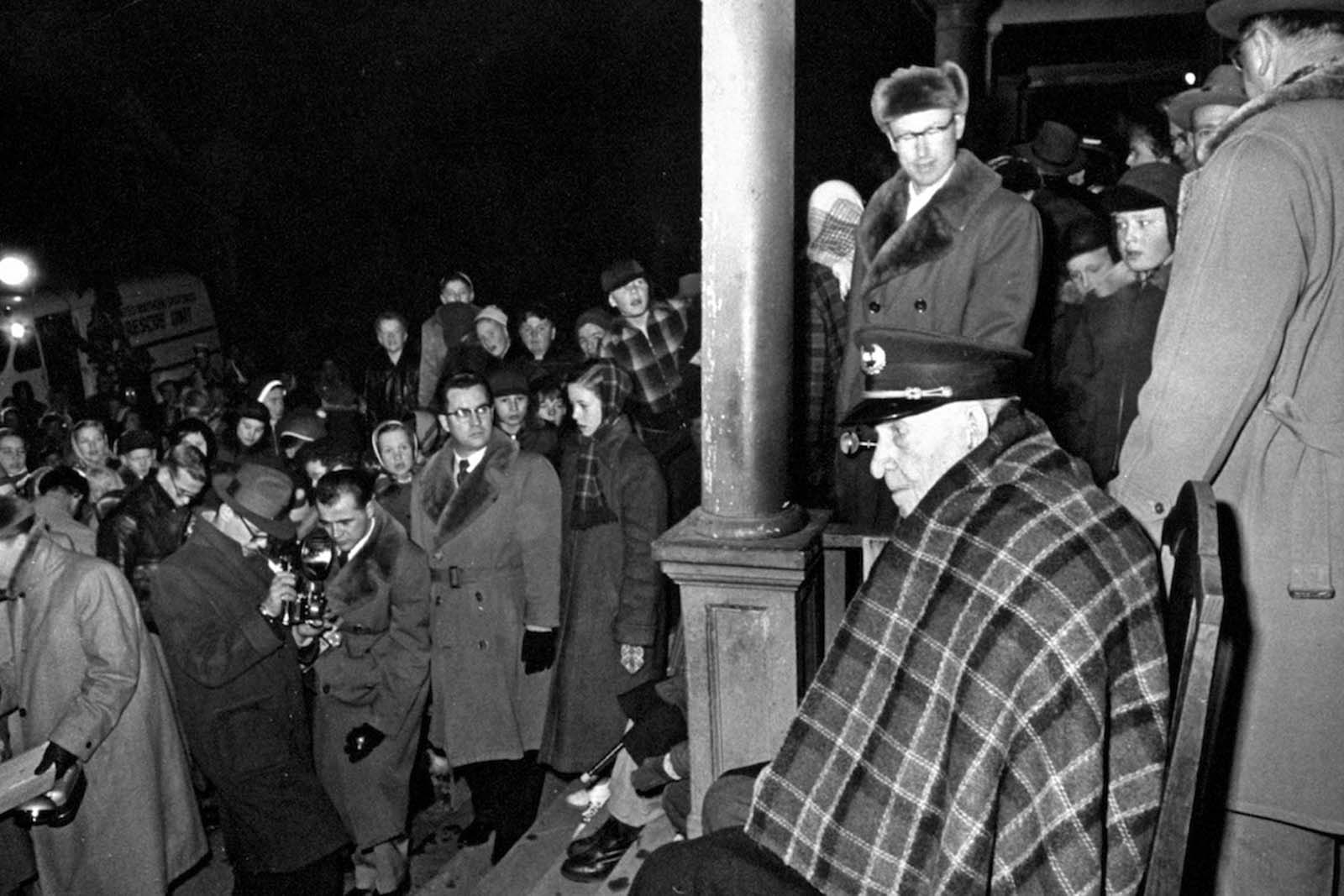
At 107 years old, Albert Woolson sits quietly on a front porch, bundled in a thick blanket and topped with a military hat that signals a lifetime tied to the Civil War’s long shadow. The title identifies him as the last remaining member of the Grand Army of the Republic (GAR), and the photograph treats that fact with a kind of gravity—an elderly figure at rest, framed by porch posts and steps, as if history itself has taken a seat.
Around him, a crowd compresses into the porch and yard, faces turned toward the veteran while photographers lean in with flash cameras ready. Heavy coats, hats, and winter collars suggest a cold evening, yet the mood is anything but distant; children and adults gather shoulder to shoulder, watching and waiting for a glimpse of a man whose memory stretches back to the 1860s. The scene feels like a public vigil, part commemoration and part curiosity, with Woolson’s stillness contrasting the busy movement of onlookers passing by.
Taken in 1954, the image becomes a meeting point between eras—mid‑century America on the steps, and the Civil War era embodied in one fragile survivor. For readers interested in Civil War history, the Grand Army of the Republic, and the culture of remembrance, this photo offers a powerful reminder of how long the conflict lingered in living memory. It’s not only a portrait of a veteran, but also a candid record of how communities gathered to witness the closing of a chapter.