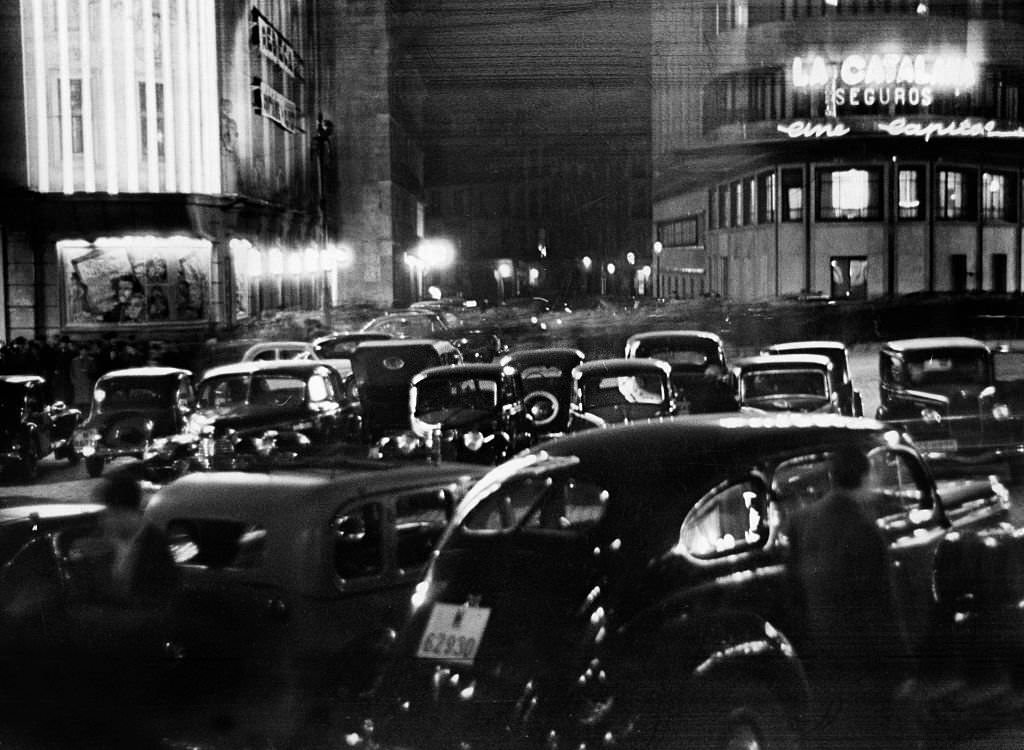
Neon lettering glows above a crowded boulevard as rows of cars pack the street, their curved bodies catching the reflected light of shopfronts and streetlamps. The scene feels unmistakably urban and modern, a nighttime Spain where commerce and movement press forward even as the city’s edges fade into grainy shadow. Architectural facades and bright signage hint at a capital-like bustle without pinning the moment to a single address.
Under the regime of Francisco Franco, everyday life often unfolded in contradictions—public order and private aspiration, restraint and the pull of consumer modernity. Photographs like this are valuable precisely because they don’t rely on official ceremony; instead, they linger on traffic jams, illuminated businesses, and the ordinary rhythm of people navigating work and leisure after dark. The result is a street-level view that complements broader narratives of civil conflict and authoritarian rule by showing what “normal” could look like in practice.
For readers exploring Spain’s post–Civil War decades, this image serves as an evocative entry point into the textures of the era: policing and propaganda existed alongside cinemas, storefronts, and the rise of car culture. The density of vehicles suggests growth and constraint at once—prosperity for some, congestion for all—framed by a cityscape where light becomes a symbol of both progress and surveillance. In the end, the photograph invites a closer look at Francoist Spain beyond slogans, through the lived experience of its streets.