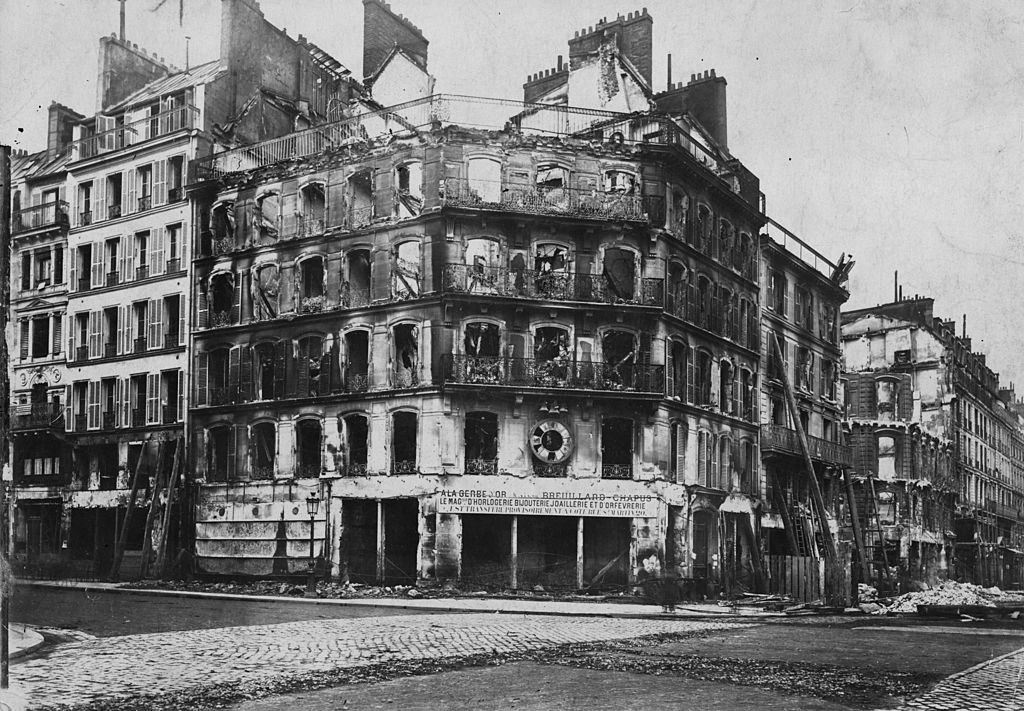
Rows of shattered windows and scorched masonry dominate the streetscape, turning what was once a busy Parisian corner building into a hollowed shell. The façade still holds its elegant lines and balconies, but the missing roof sections, blackened upper floors, and torn interiors make the violence unmistakable. Debris gathers along the curb and the cobbled roadway lies strangely open, emphasizing how bombardment can empty a city of its ordinary rhythms in an instant.
Set against the turmoil of the Franco-Prussian War and the Paris Commune, the scene speaks to a double crisis: foreign occupation and internal conflict, each leaving marks on the same urban fabric. Commercial signage remains visible at street level, a reminder that these were not distant fortifications but lived-in blocks where trades, tenants, and passersby once clustered. The contrast between intact neighboring buildings and the blasted corner structure highlights how destruction arrived unevenly, street by street.
For readers interested in the history of Paris, civil wars, and nineteenth-century warfare, this photograph offers a stark, street-level view of what “bombarded buildings” meant in practical terms—broken homes, ruined businesses, and a skyline cut apart. It also preserves architectural details that survived long enough to be recorded: ironwork railings, stacked floors, and the familiar Parisian rhythm of windows now rendered vacant. As an artifact of conflict, the image invites reflection on how political upheaval and military force reshape cities, leaving scars that photographs can trace long after the smoke has cleared.