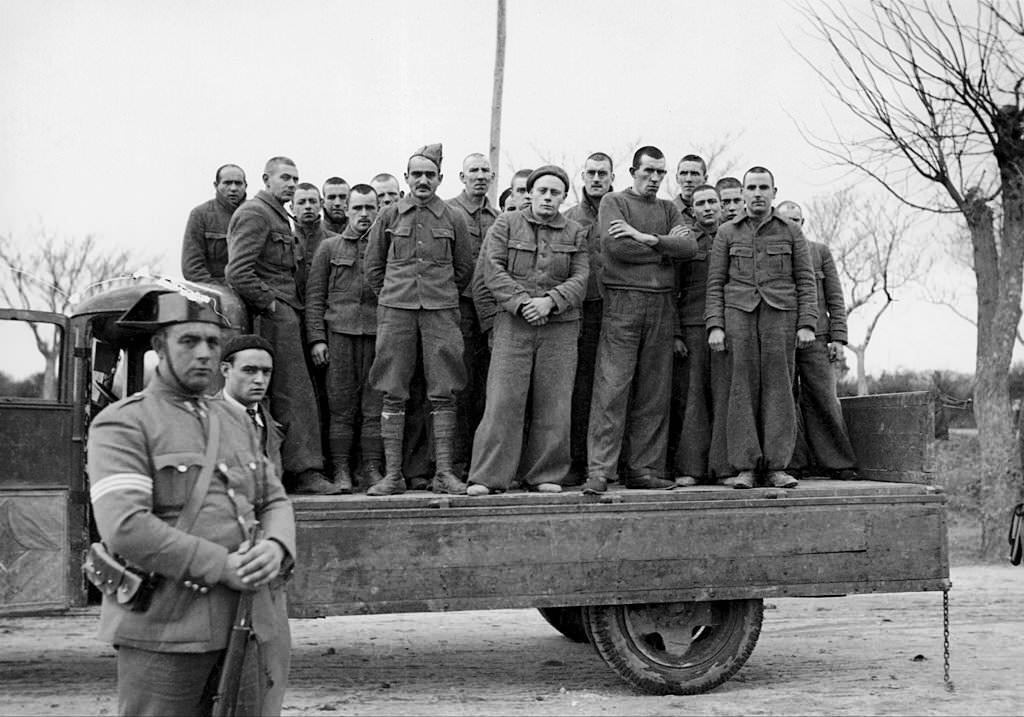
A crowded lorry bed becomes an uneasy stage as a group of captured English soldiers stand shoulder to shoulder, their heavy coats and close-cropped hair suggesting a hurried, hard season. In the foreground, an armed guard anchors the scene, partially out of focus yet unmistakably present, while bare winter trees and open ground frame the sense of exposure. The title places the moment near Madrid in 1939, at the end of the Spanish Civil War, when the fate of foreign volunteers and prisoners could turn on politics as much as on battlefield fortunes.
Faces do much of the storytelling here: some stare directly into the lens, others look past it, and several fold their arms as if bracing against cold, fatigue, or uncertainty. The men’s clothing appears utilitarian rather than ceremonial—workmanlike jackets, loose trousers, and practical boots—hinting at the stripped-down realities of captivity. Small details—the high wooden sides of the truck, the chain hanging beneath, the tight formation—underscore the controlled movement of prisoners arriving at a camp.
Spanish Civil War photographs like this one pull the conflict out of maps and communiqués and back into the human scale of waiting, transport, and surveillance. The image also serves as a reminder of the international dimension of the war, with English-speaking fighters and detainees caught in Franco’s advance and the consolidation of power around Madrid. For readers searching for archival material on 1939 Spain, Franco’s troops, and wartime prisoners, this historical photo offers a stark, immediate window into the final months of a civil war that reshaped a nation and echoed far beyond its borders.