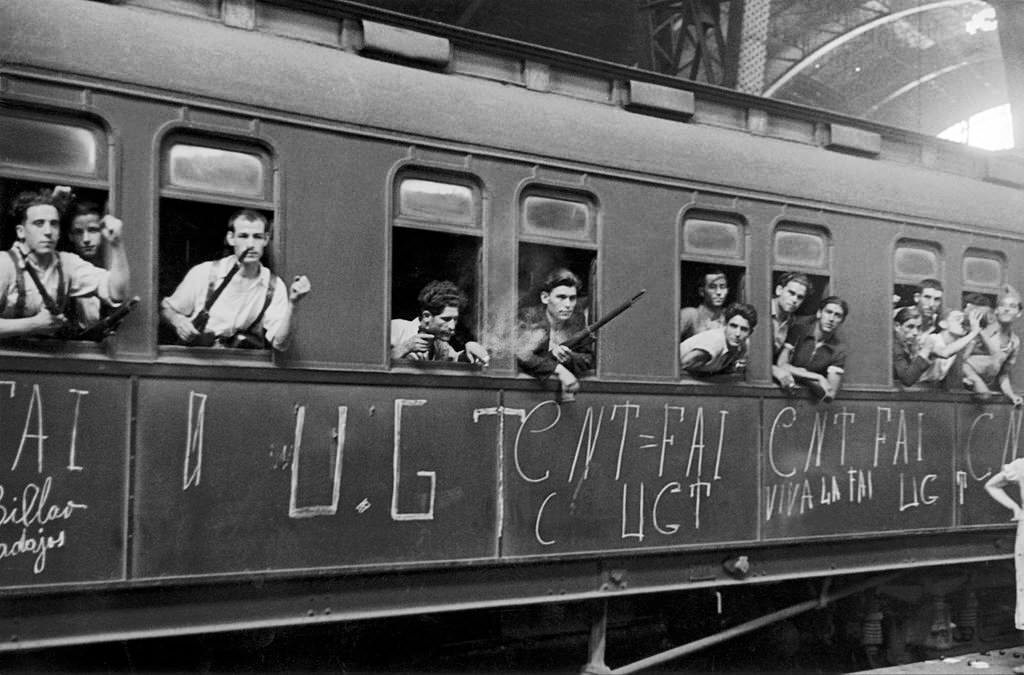
Crowded train windows frame a row of young Madrileños as they lean out into the station air, some gripping rifles, others raising clenched fists in a gesture of resolve. The carriage side is covered with chalked slogans and initials, turning the metal body into a moving wall of messages that would have been understood instantly by fellow supporters. Faces press close to the openings—alert, intense, and watchful—capturing the tense mix of excitement and uncertainty that accompanied departure for the front in 1936.
Rail travel became an essential artery of the Spanish Civil War, and the platform scene here hints at the rapid mobilization of workers who volunteered for the Spanish Republican Army. Clothing reads as everyday and practical rather than formal uniform, underscoring how quickly civilian life could be repurposed for conflict. The composition draws the eye along the line of windows, emphasizing collective action—many individuals, one direction—while the station architecture above suggests an urban setting consistent with the title’s reference to Madrid.
Propaganda, solidarity, and street-level politics are written directly onto the train in bold, improvised lettering, a reminder that the war was fought with symbols as well as weapons. For readers searching Spanish Civil War history, Republican volunteers, or Madrid in 1936, this photograph offers an immediate, human-scale view of departure: a moment suspended between home and battlefield. Seen today, the image invites reflection on how working-class identity, political allegiance, and the logistics of modern transport converged at the very start of a long, brutal conflict.