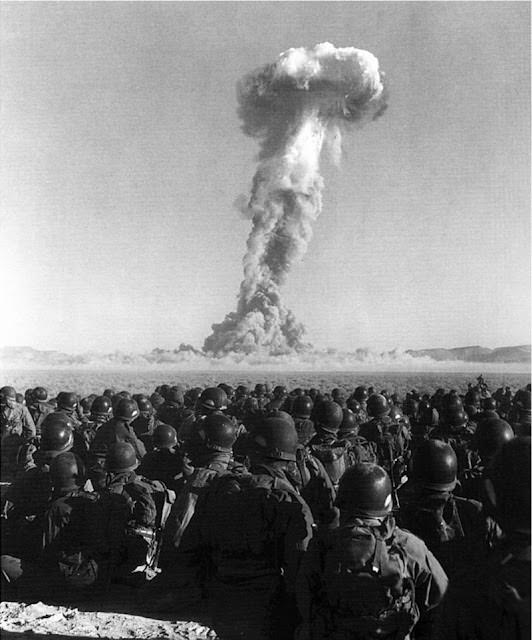
A line of helmeted soldiers fills the foreground, their backs turned toward a distant horizon where a towering mushroom cloud rises into a pale sky. The stark contrast between the clustered human figures and the immense column of smoke makes the scene feel both clinical and overwhelming, a reminder of how closely military observation and scientific spectacle were intertwined. Titled “Atom bomb test, 1951,” the photograph evokes the early Cold War era’s fixation on proving power in the open air.
Dust and debris spread outward at ground level while the cloud’s stem thickens into a dark, churning base, then blooms into a capped plume that seems to hang above the landscape. The camera’s wide view emphasizes scale: the blast dominates the frame, yet the observers are numerous enough to suggest routine, as if witnessing nuclear detonation had become another briefing in the field. Details like uniforms, gear, and the orderly mass of troops underscore the military setting without revealing a specific site.
For readers searching for a 1951 atom bomb test photo, Cold War nuclear testing imagery, or archival military history pictures, this post offers a vivid window into the period’s uneasy normalization of atomic power. The image also resonates beyond strategy and technology, inviting questions about training, safety assumptions, and the psychological distance created by watching catastrophic force from a designated vantage point. In that tension—between awe, discipline, and dread—lies much of the era’s historical truth.