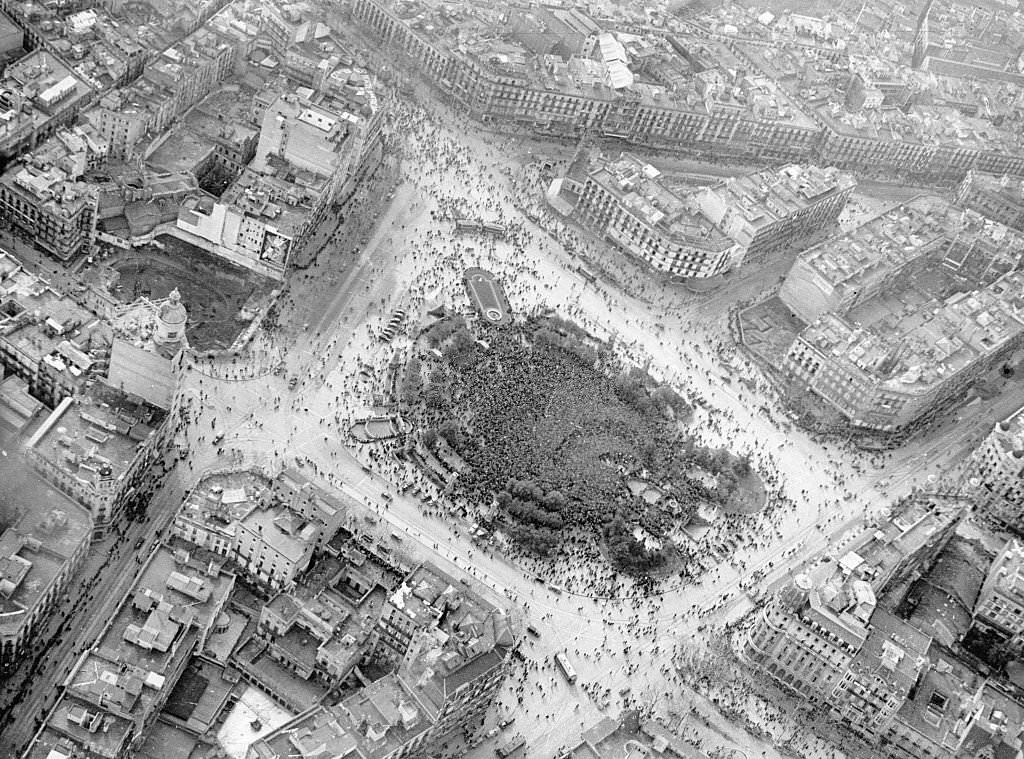
From high above Barcelona, the broad geometry of Plaça de Catalunya opens like a stage, with radiating avenues feeding into a central island of trees. The crowd gathers thickest in and around that greenery, forming a dark, dense mass against the pale streets, while the surrounding blocks of stone buildings and curved facades frame the scene with unmistakably urban grandeur. Tiny figures spill along the sidewalks and cross the junctions, giving a sense of scale that turns the square into a living map of a city in upheaval.
The title’s “victory celebration” reads differently when viewed from a bird’s-eye perspective: people become patterns, movement becomes flow, and the square becomes an instrument of power and public emotion. In the context of the Spanish Civil War, this moment follows the collapse of Republican defense in Catalonia and the Nationalist capture of Barcelona, when civic space was rapidly redefined by the new authorities and their supporters. The aerial vantage emphasizes control and visibility, suggesting how modern conflict and propaganda could use the city itself as a backdrop for announcing a new order.
Look closely at the circulation around the plaza—the way crowds cluster, thin out, and reform along the avenues—and you can almost trace the currents of attention, curiosity, and coercion. The photograph is a striking historical record of Barcelona’s Plaça de Catalunya at a pivotal wartime turning point, useful for readers searching Spanish Civil War images, Barcelona history, or Nationalist occupation-era photographs. What it cannot show, and what makes it haunting, is the private cost behind a public spectacle: the fear, displacement, and silence that often follow a captured city even as a celebration fills its streets.