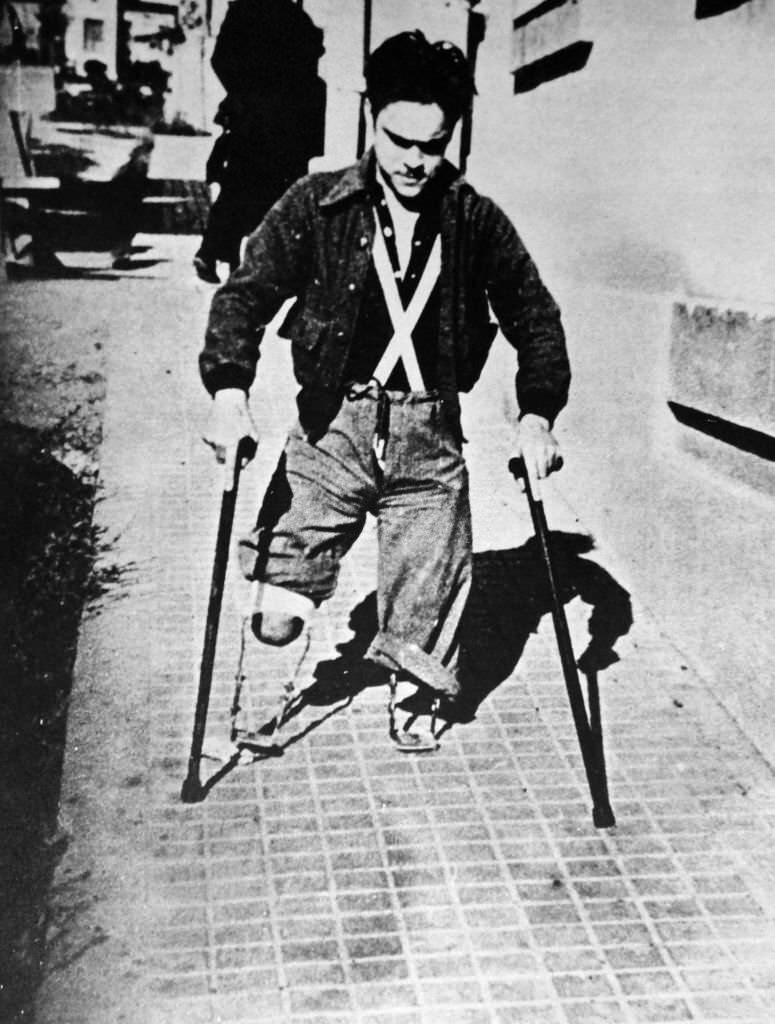
A lone amputee war veteran moves down a Spanish street on two crutches, his gaze lowered in concentration as he negotiates the patterned pavement. Suspenders cross his chest in a bold X, and the hard contrast of the photo throws his figure into sharp relief against the bright wall beside him. In the blurred background, a passerby and the hint of buildings receding down the lane suggest ordinary life continuing at the edge of upheaval.
War is often remembered through battles and banners, yet scenes like this reveal the conflict’s enduring aftermath: injury, adaptation, and the daily work of survival. The veteran’s posture—steady but strained—speaks to resilience without romance, a human body forced to relearn the city’s simplest distances. As a Spanish Civil War photograph, it draws attention to the people who carried the consequences long after gunfire moved elsewhere.
Street-level images from civil wars can be deceptively quiet, offering historians and readers a rare closeness to lived experience. The cramped sidewalk and stark sunlight frame disability not as spectacle but as a fact of public life, one step at a time. For anyone searching Spanish Civil War history, wartime civilian life, or the legacy of wounded veterans, this photograph provides a compelling, intimate window into the era.