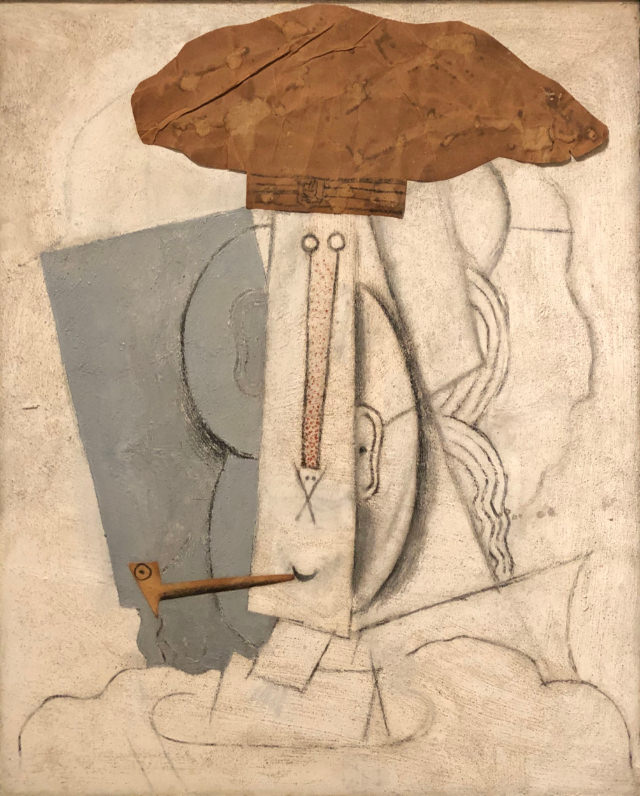
Paper and pigment meet in a witty, pared-down portrait where cut shapes do as much storytelling as the drawn line. A broad, brown hat sits like a roof over a pale, angular face, while a long nose and small, circular eyes give the figure an almost mask-like presence. The collage elements—especially the gray-blue plane behind the head—create depth with minimal means, letting texture and edge become part of the composition.
What makes this kind of cut-paper work feel so rare is its immediacy: you can sense the artist thinking with scissors, rearranging form like a mosaic made from scraps. A slender pipe juts outward, turning the profile into a sly silhouette, while the graphite sketching around it remains visible, unfinished in a deliberate way. That tension between the precise cut and the searching outline is the quiet drama of the piece, and it’s exactly what draws collectors and art historians back to these experiments.
Seen through the lens of “Paper Mosaics: Picasso’s Rare Cut-Paper Artworks,” the image becomes a reminder that modern art history isn’t only oil paint and grand canvases—it’s also humble paper, pasted layers, and playful construction. The worn surface, faint smudges, and overlapping shapes highlight process as much as result, making the artwork feel intimate and studio-close. For readers browsing Picasso collage, cut-paper art, and modernist portrait studies, this post offers a textured glimpse into how radical simplicity can be.