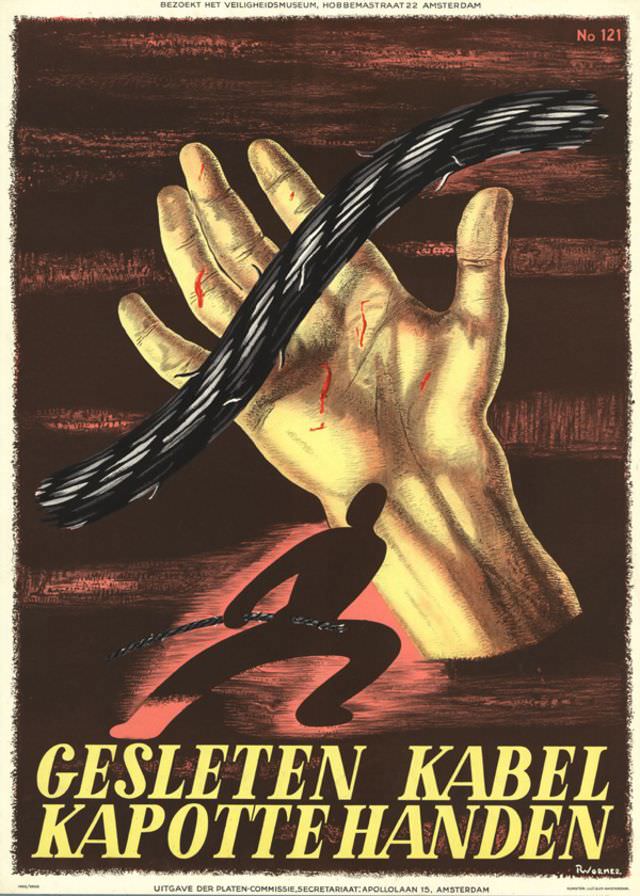
A stark warning dominates R. Wormer’s 1952 poster: a large, open hand marked with red scratches, a severed black cable arcing across the palm like a whip. Beneath it, a crouching figure moves through a red-lit space, suggesting the everyday worker caught in a moment of danger. The bold Dutch slogan “GESLETEN KABEL KAPOTTE HANDEN” lands with blunt clarity, tying frayed wiring to real, immediate injury.
The design relies on dramatic contrast—dark browns and blacks against pale skin tones and a flare of red—to make the hazard feel unavoidable. Even without a clutter of details, the message reads instantly: neglect the condition of electrical cables and the consequences are bodily, not abstract. The torn border and simple forms evoke mid-century safety graphics, where persuasion depended on strong symbols and a touch of alarm.
Text at the top invites viewers to “BEZOEKT HET VEILIGHEIDSMUSEUM” and includes an Amsterdam address, placing the poster within a broader campaign of public instruction and industrial safety education. As an artwork and a piece of working-life history, it offers excellent material for readers searching for vintage Dutch poster design, workplace safety propaganda, and 1950s graphic communication. Wormer’s composition turns a routine maintenance issue into a memorable visual lesson—one that still reads sharply today.