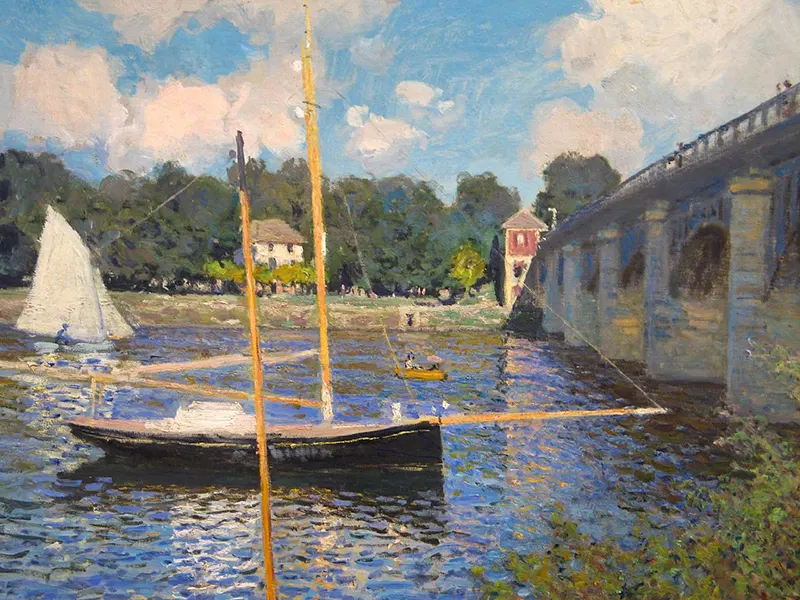
Along the river at Argenteuil, small sailboats drift in a breeze that seems to ripple right off the paint, their masts cutting clean lines through a sky scattered with soft, sunlit clouds. The water is rendered in quick, lively strokes—blues, violets, and flashes of reflected light—so the surface feels restless and immediate, like a summer afternoon caught mid-glimmer. Across the far bank, trees and low buildings sit in a calm band of green and pale walls, setting a quiet backdrop for the leisure of the scene.
To the right, a broad stone bridge anchors the composition with weight and shadow, its arches marching into the distance while figures gather along the top edge as tiny silhouettes. The contrast between solid masonry and shimmering current heightens the sensation of movement, and the bridge’s cool tones temper the warmth of the sky and water. Near the bridge, a small riverside structure with a reddish facade provides a bright accent, guiding the eye back toward the middle of the river where boats, oars, and sailcloth punctuate the open space.
Held today by the National Gallery of Art in Washington, D.C., “Argenteuil, 1874” speaks to the period’s fascination with modern recreation and the changing face of riverside towns. The painting’s fresh color, broken brushwork, and attention to light make it an inviting touchstone for anyone searching for Argenteuil art, 1874 paintings, or French river scenes in museum collections. Whether you come for art history or simply for the pleasure of water and sky, the work offers a vivid window onto a moment when industry and leisure met on the same sparkling current.