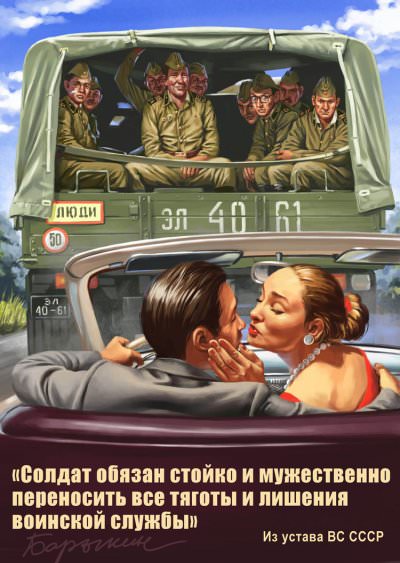
A crowded military truck rumbles through the background, its canvas sides pulled high so a row of uniformed men can look out at the road and the world beyond it. Their faces—some curious, some weary, some quietly amused—compress the experience of service into a single moment of being packed together, carried along, and expected to endure. The composition immediately frames military life as something shared and unavoidable, with little room for privacy or comfort.
In the foreground, a civilian couple leans into a kiss inside an open car, stylishly dressed and insulated—at least for a moment—from the constraints behind them. The contrast is sharp: intimacy and choice in front, regimented movement and collective hardship above, as if two realities briefly intersect at the same roadside pause. Even without knowing the exact time or place, the visual language reads like propaganda art, using romance and everyday luxury to heighten the sense of deprivation faced by conscripts.
Beneath the scene, Cyrillic text reinforces the message, insisting that a soldier must bear the burdens and privations of military service with steadfast courage, and it cites a Soviet military statute. That official tone turns the image into more than a mere illustration; it becomes a moral instruction, asking viewers to accept sacrifice as duty rather than misfortune. For readers interested in Soviet-era military culture, wartime messaging, and the psychology of service, this artwork offers a vivid, SEO-friendly window into how hardship was not only experienced, but also publicly defined and demanded.