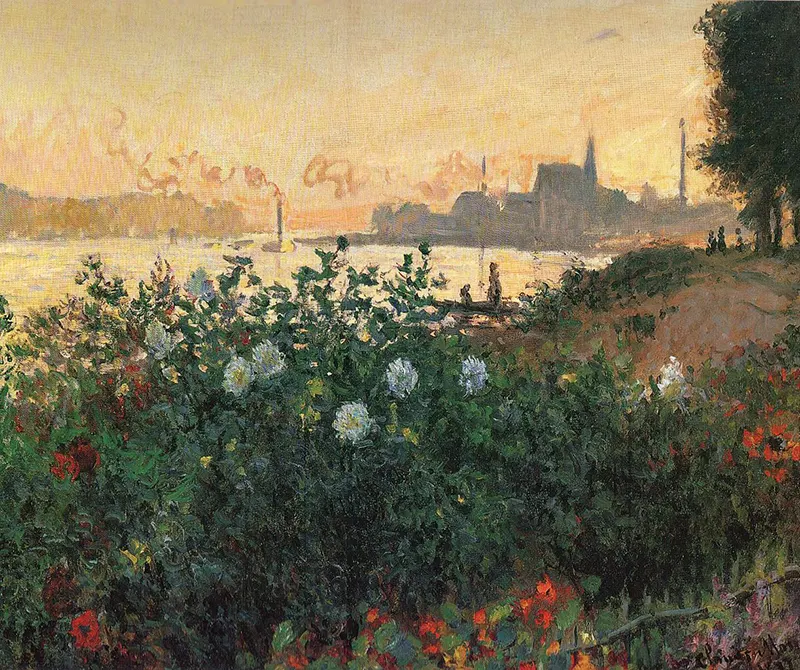
Flowers crowd the foreground in thick, lively strokes, their whites and reds flickering against deep greens as if caught in a passing breeze. Beyond the blossoms, the river opens into a pale, shimmering band of light, and the far bank dissolves into soft silhouettes—spires and rooftops hinted at rather than outlined. The composition draws the eye from the tactile garden edge to the airy distance, a hallmark of late-19th-century landscape painting and its fascination with fleeting atmosphere.
Across the water, industry and town life linger as quiet suggestions: a thin plume of smoke, clustered buildings, and the faint geometry of architecture softened by haze. Small human figures near the shore add scale without breaking the calm, implying an everyday riverside moment rather than a staged scene. The palette moves between warm sky tones and cool reflections, inviting close looking at how color, light, and texture build the sense of place around Argenteuil.
Held by the Pola Museum of Art in Japan, “Flowers on the Riverbank at Argenteuil, 1877” speaks to the enduring global reach of European art and the way such works travel through collections and time. For readers searching for Argenteuil riverbank art, 1877 landscape painting, or museum-held masterpieces, this image offers a rich entry point: a garden’s immediacy set against a modernizing horizon. It’s a river view that balances beauty and change, preserving a tranquil edge of nature beside the distant pulse of a town.