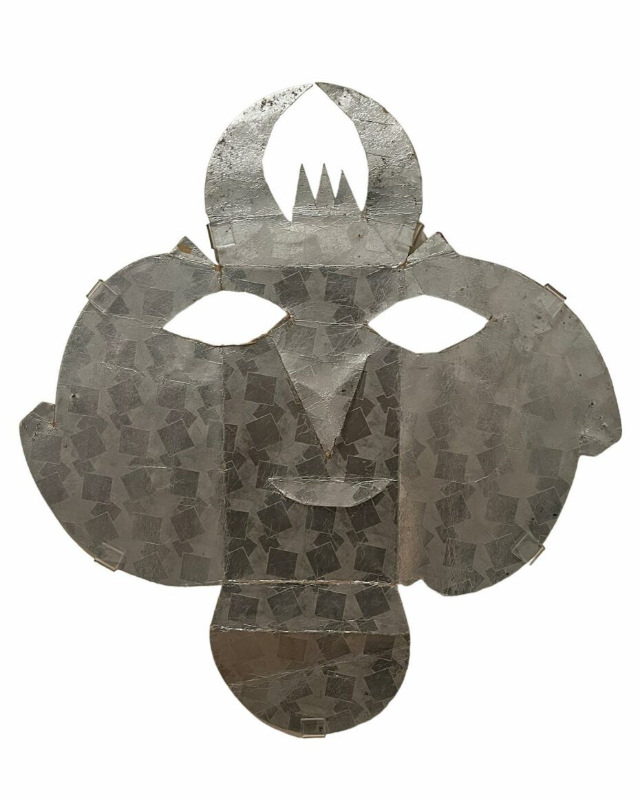
Set against a clean white field, a stylized face emerges from a patchwork of cut paper, its surface built from countless small fragments that read like a hand-laid mosaic. The almond-shaped eye openings and simplified nose create an unmistakably mask-like presence, while the rough edges and visible joins keep the work grounded in touch and improvisation. Even in a restrained palette, the shifting tones and overlapping pieces add depth, inviting a closer look at how the image was assembled.
Paper becomes both drawing and sculpture here: planes are stacked, seams are taped or pasted, and the geometry of the collage does the work of line. The crown-like form above the head, with sharp cutouts and a circular arch, gives the composition a theatrical silhouette, as if the figure were meant for performance or ritual. Each irregular scrap carries its own history of handling, turning a simple material into a record of process—an important clue when exploring Picasso’s rare cut-paper artworks and the inventive methods surrounding them.
For readers searching for Picasso collage art, cut-paper experiments, or modernist paper mosaics, this piece offers a compact lesson in how bold forms can rise from humble materials. The photograph emphasizes texture and construction as much as design, highlighting the artist’s ability to fuse craft, play, and abstraction into a single emblematic face. As a WordPress feature, it’s a compelling reminder that some of the most enduring images in art history are built not from grand gestures, but from patient cutting, arranging, and making-do with what’s at hand.