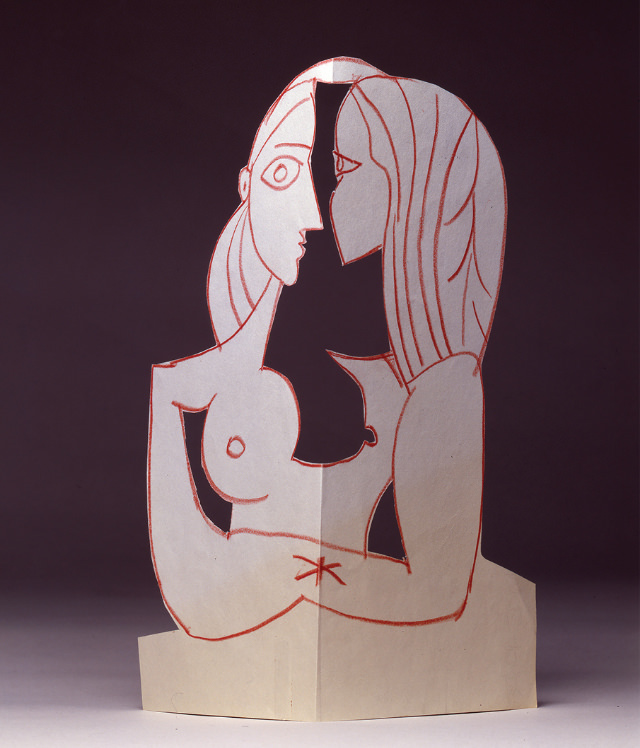
Bold, pared-down outlines meet delicate paper craft in this striking cut-paper composition attributed in the title to Picasso, where two stylized figures are reduced to clean planes and a few decisive red lines. The forms interlock like a small paper mosaic—faces nearly touching, profiles echoed, and negative space doing as much work as the drawn contour. Set against a deep, dark background, the pale paper takes on a sculptural presence, emphasizing folds, edges, and the hand-cut silhouette.
What makes the scene linger is its quiet tension: one figure reads as a light, frontal body with simplified features, while the other becomes a darker, shadowed counterpart, creating a visual dialogue between presence and absence. The spare linear marks suggest hair, gaze, and gesture without drifting into realism, a hallmark of modernist abstraction and collage thinking. Even without a visible studio context, the piece conveys how paper—often treated as a humble material—can carry the authority of a finished artwork.
For readers drawn to modern art history, collage, and rare works on paper, “Paper Mosaics: Picasso’s Rare Cut-Paper Artworks” points to an overlooked corner of 20th-century experimentation where drawing, sculpture, and design overlap. The photograph invites close looking at technique: the cut edges, the layered construction, and the way a minimal palette amplifies emotion and structure. Whether you arrive here searching for Picasso cut-paper art, paper collage artworks, or modernist paper mosaics, this post offers a memorable glimpse of how simplicity can be engineered for maximum impact.