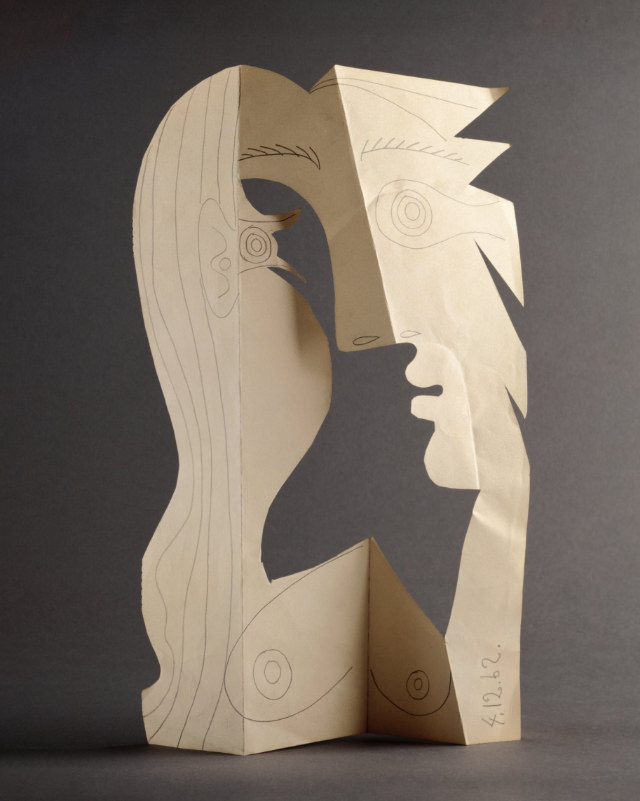
A folded sheet of pale paper rises from a dark backdrop, turning a simple cut-out into a small standing sculpture. The face is split into two profiles that meet in the center, their eyes marked by tight spirals and their expressions suggested with the lightest pencil lines. Creases and shadows do as much work as the drawing itself, giving the work a quiet, architectural presence that feels both playful and precise.
Picasso’s cut-paper experiments reveal how he could build a portrait with almost nothing—just a blade, a few curves, and the confidence to let empty space speak. Here, the jagged, crown-like edge on one side contrasts with the smooth sweep of hair on the other, while the folded base anchors the figure like a stage prop. The result reads as a paper mosaic in three dimensions, balancing Cubist fragmentation with the intimacy of hand-drawn marks.
For readers searching Picasso paper cutouts, rare collage studies, or modernist paper artworks, this piece offers a direct look at process as much as outcome. The neutral setting keeps attention on material and technique: the softness of the paper, the crispness of the cuts, and the way light turns a sketch into form. It’s a reminder that some of the most enduring innovations in modern art begin with humble tools and a single sheet transformed.