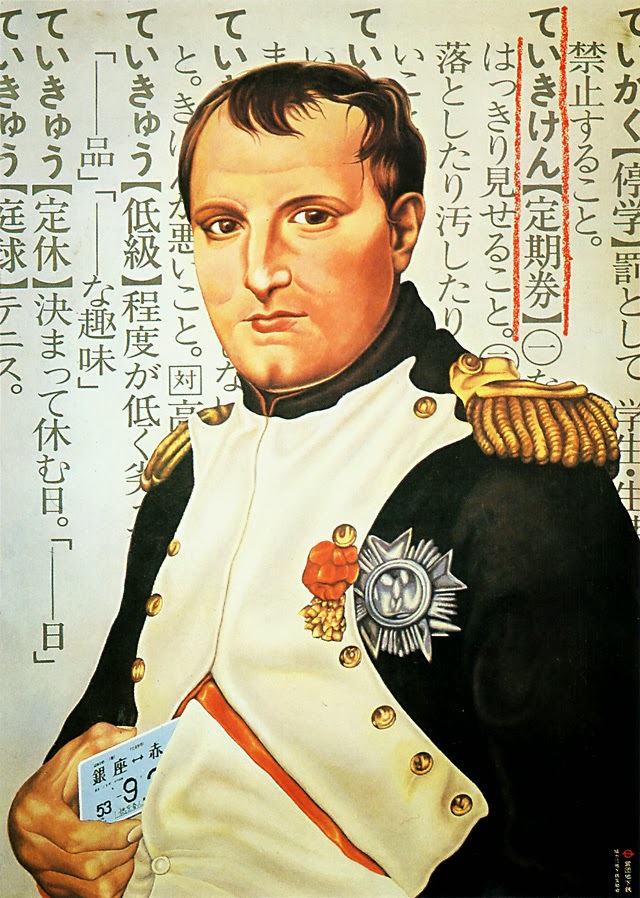
A stern, uniformed figure—rendered with the polish of a poster or magazine illustration—faces the viewer head-on, epaulettes and medals carefully picked out against a pale background of Japanese text. The composition feels like a collision of eras: a European-looking military portrait set amid modern typography, with the lettering repeating and crowding in like station signage. That juxtaposition turns the scene into an “artworks” moment rather than a straightforward documentary image, inviting you to read the page as much as you study the face.
Near the lower edge, a small ticket-like slip marked “9” peeks out from a hand, making the post title, “Clearly show your train pass (September 1978),” land with a wry punch. The Japanese characters include a bold, vertical “禁止” (“prohibited/forbidden”), the kind of emphatic language associated with rules and public notices, and it reinforces the theme of compliance: show the pass, follow the instructions, keep moving. Even without a visible station platform, the visual grammar of transit culture—tickets, warnings, printed directives—anchors the image in everyday mobility.
Posted under “Artworks,” the piece reads as a playful meditation on authority: military regalia mirrored by civilian regulation, both insisting on order in their own way. For anyone interested in Japanese graphic design, poster art, or the texture of late-1970s public messaging, this image offers plenty to linger over—the typography, the satirical edge, and the way a humble pass becomes the center of attention. It’s a reminder that history isn’t only preserved in grand events; sometimes it’s tucked into the rules we were told to obey on the way to somewhere else.