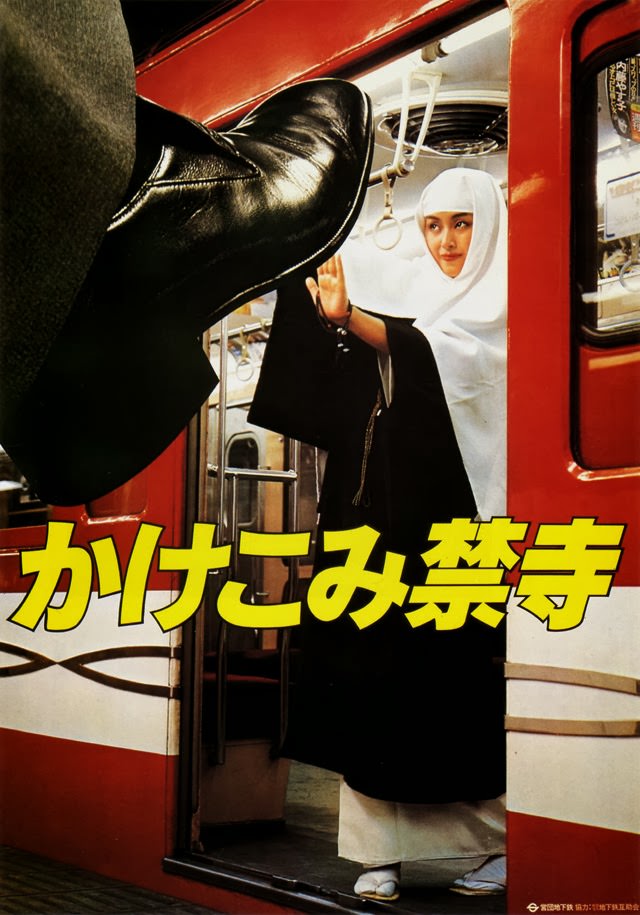
A subway doorway glows with glossy red paint while a single black shoe lunges into the frame, frozen mid-step as if the rider is about to force their way inside. Behind the threshold stands a woman in a striking white head covering and dark robe, one palm raised in a clear “stop” gesture that turns the moment into a warning. Overhead hand straps and the tight interior details place us squarely in the everyday crush of urban rail travel, yet the composition feels closer to poster art than casual documentation.
The title, “Do not rush onto the train (April 1979),” frames the scene as a safety message about platform behavior and boarding etiquette, a topic that became increasingly urgent as commuter systems grew busier. Rather than showing a chaotic crowd, the photographer (or designer) chooses symbolism: the aggressive shoe represents impatience, while the calm, centered figure at the door signals restraint and control. Even without a readable location in English, the Japanese text and transit styling strongly suggest a Japanese public-transport context, making this a memorable piece of late-1970s railway visual culture.
For anyone interested in transportation history, Japanese graphic design, or the evolution of public safety campaigns, this image offers a vivid snapshot of how institutions communicated with riders before digital signage and screen ads. The strong color contrast, theatrical perspective, and staged clarity make it highly shareable as a historical photo, while still pointing back to practical concerns—crowding, door safety, and the everyday risks of rushing. It’s an artwork with a civic purpose, reminding modern viewers that the simplest instruction can be delivered with unforgettable style.