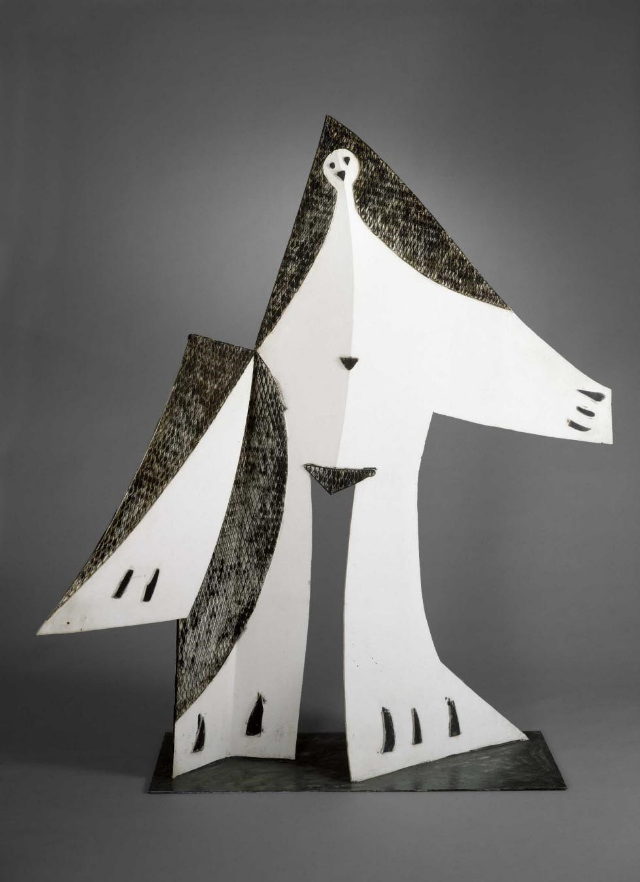
Angular sheets of paper rise like a small stage set, forming a stark figure that feels part bird, part mask, and wholly modern. The white cutouts carve clean silhouettes against the dark ground, while textured black pieces act as wings, hair, or shadow—depending on how your eye wants to read them. In this “Paper Mosaics” view of Picasso’s rare cut-paper artworks, the simplest materials become a bold design that stands upright, nearly sculptural in its presence.
Look closely and the economy of marks is striking: a single oval becomes an eye, a narrow triangle suggests a nose, and a few clipped slashes hint at fingers or feathers. The composition plays with symmetry and imbalance at once—broad planes on one side, a sharp projecting shape on the other—creating that familiar tension between abstraction and figure. Photographed against a plain studio backdrop, the work’s edges, overlaps, and shadows are allowed to tell the story of how it was built.
Paper collage and cut-paper art often get described as “light,” yet pieces like this carry a surprising architectural weight. The image invites art lovers and collectors to think about Picasso beyond paint and canvas, highlighting how experimentation with scissors, layering, and negative space could produce a new kind of character. For anyone searching for Picasso paper artworks, modern collage history, or rare cut-paper compositions, this post offers a vivid glimpse into an inventive corner of twentieth-century art.