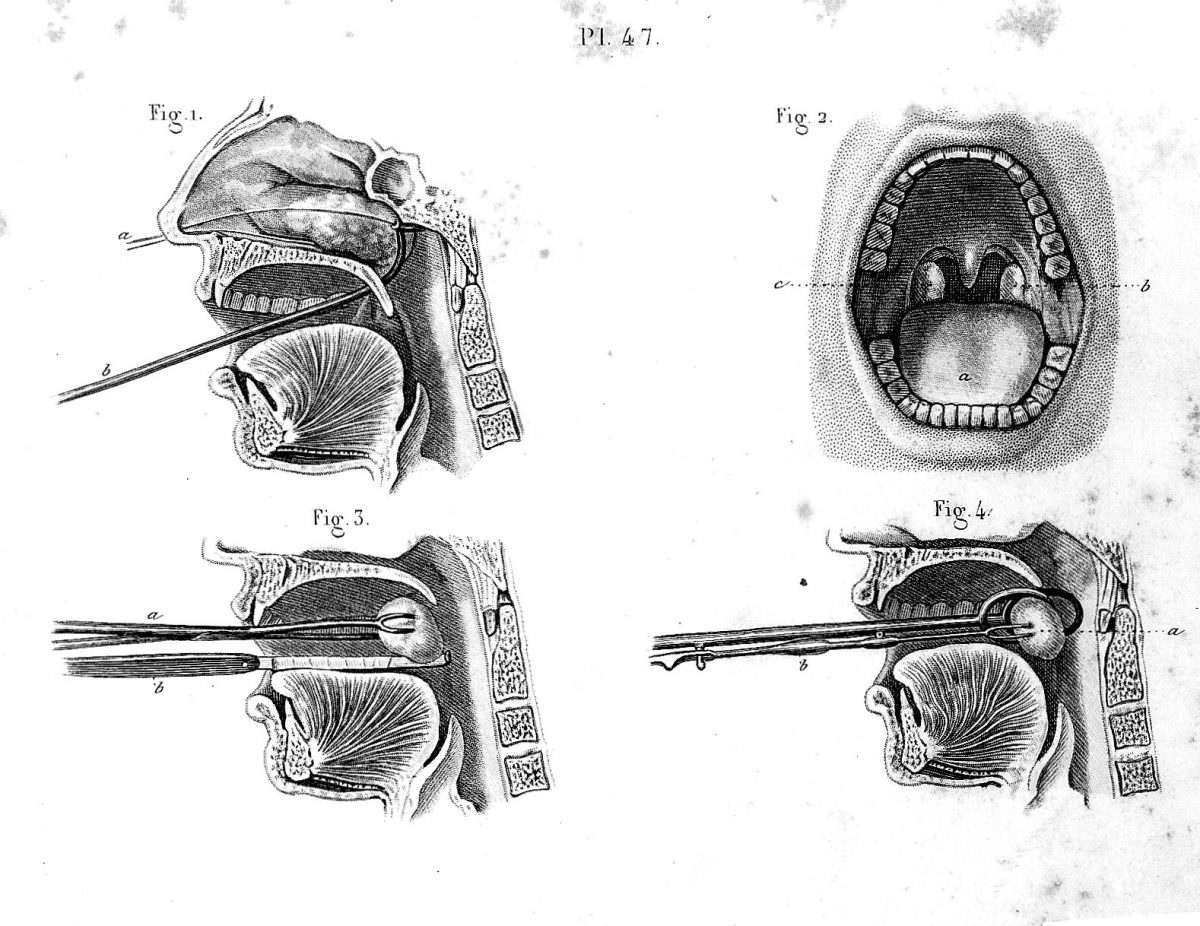
Plate 47 reads like a page torn from a 19th-century surgical manual, where anatomy and instruction meet on the same sheet. The engravings map the mouth and throat in careful sections—teeth, tongue, palate, and the deep passage toward the pharynx—rendered with the crisp linework and stippling typical of medical illustration from the era. Labeled figures and lettered callouts turn the human body into a diagram meant to be studied, copied, and acted upon.
Across the four figures, a sequence emerges: the open mouth, the instrument’s approach, and the grasping or removal of tissue described in the post title as “unwanted parts.” Long forceps extend into the throat, while cross-sectional views expose hidden spaces that would have been difficult to visualize during an operation. For modern readers, these images offer a stark window into pre-digital medicine—when surgeons relied on printed plates to standardize technique and communicate procedure.
Seen today, the artwork carries two stories at once: the clinical ambition to control the body through surgery, and the visual culture that made such intervention legible on paper. Collectors of antique medical prints, historians of surgery, and anyone researching 19th-century anatomy will find plenty to examine in the composition, terminology, and instrument depiction. As a WordPress feature, it works both as a compelling historical artifact and as searchable documentation of surgical illustration, anatomical engraving, and early operative practice.