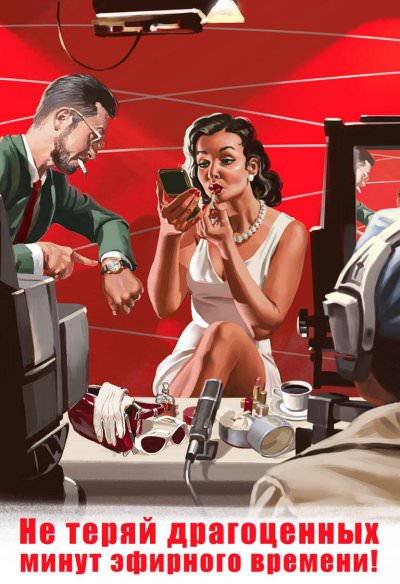
Bright studio lights glare against a saturated red backdrop as a glamorous performer perches at a crowded makeup table, checking her lipstick in a compact mirror. Around her, the tools of production press in close—cameras, microphones, cables, and scattered cosmetics—turning the act of getting ready into a spectacle of its own. The title, “Do not waste precious minutes of airtime,” lands like a stage manager’s bark, reminding everyone that in broadcast work, time isn’t just money; it’s the show.
At the edge of the scene, a stern man in a suit points to his wristwatch, an unmistakable gesture of impatience that contrasts with the calm precision of the woman’s touch. The composition plays with tension: personal vanity versus professional urgency, artistry versus schedule, human ritual versus mechanical routine. Even without a named station or visible date, the styling and studio equipment evoke the mid-century world of radio and television, when live minutes were unforgiving and delays were public.
Lettering along the bottom, printed in bold Cyrillic, frames the piece as a cautionary message as much as an artwork. It reads as propaganda-adjacent workplace advice—part humor, part discipline—aimed at workers who learned to treat broadcast time as a scarce resource. For anyone searching vintage broadcasting posters, Soviet-era studio imagery, or historical media ephemera, this scene offers a vivid reminder that “airtime” has always been precious, and that the pressure behind the scenes can be as dramatic as what reaches the audience.