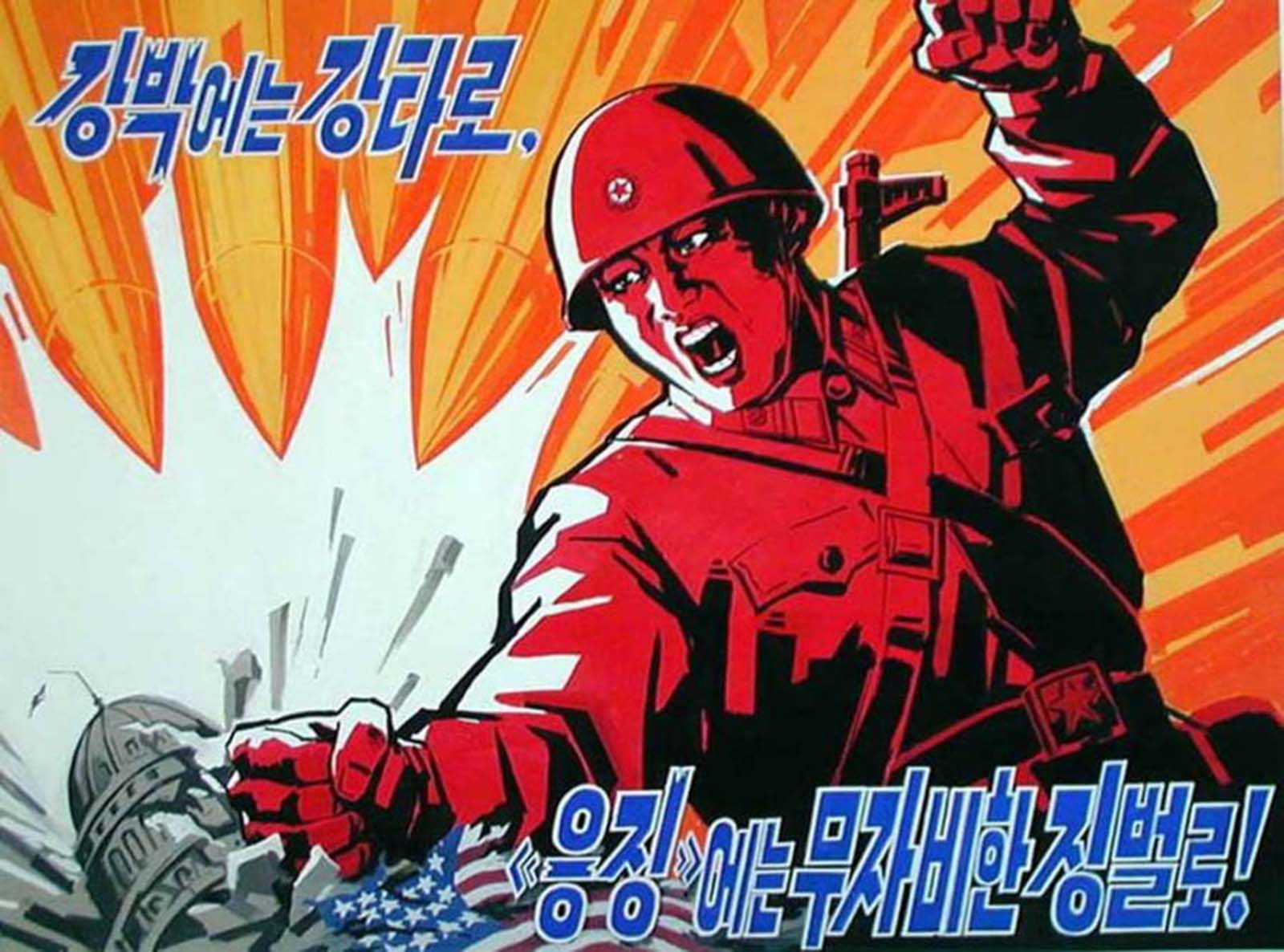
A clenched fist, a shouting face, and a burst of jagged color turn this artwork into a blunt command rather than a quiet scene. The composition leans hard into motion—helmeted figure thrust forward, arm raised, and an impact rendered like an explosion—while bold Korean lettering frames the message as something meant to be read from a distance and felt instantly. Even without naming a specific place or moment, the styling signals the world of wartime propaganda: simplified forms, high contrast, and a single, unmistakable emotion.
The post title, “Fight compulsion with hard hits, punishment with ruthless payback,” lands like an echo of the image’s visual violence, translating ideology into bodily force. In the lower corner, a damaged emblem resembling the United States flag appears beneath debris, a clear cue that the target is foreign and the tone is confrontational. Red dominates the palette, not as decoration but as psychological pressure—urgency, anger, resolve—paired with sharp yellows and whites that mimic shockwaves and shrapnel.
As a historical piece for collectors of political posters and Cold War–era graphic art, it offers a lesson in how states used typography, caricature, and exaggerated heroism to sell conflict as moral necessity. The language and imagery work together to dehumanize an opponent and glorify retaliation, inviting viewers to identify with the striking figure rather than question the strike itself. For readers exploring Korean propaganda art, militarized visual culture, or the rhetoric of anti-American imagery, this print stands as a vivid example of persuasion engineered through spectacle and threat.