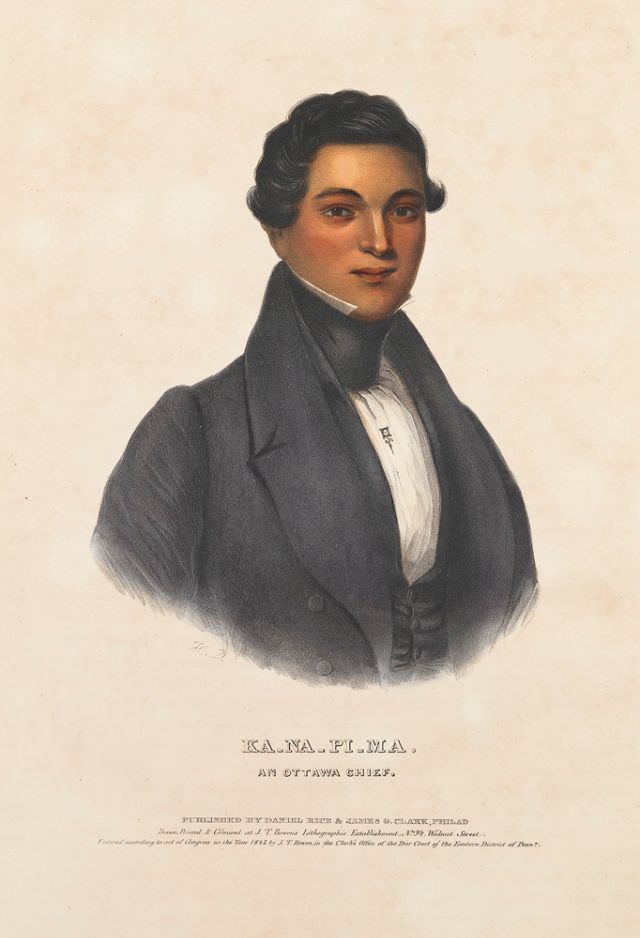
Rendered with a soft, restrained palette, this portrait titled “Ka-Na-Pi-Ma, An Ottawa Chief” focuses on a composed young man set against an uncluttered background, inviting attention to expression and dress rather than scenery. The sitter’s dark, wavy hair and steady gaze are modeled with careful shading, while the gentle blush of the cheeks and the crisp highlights on the collar give the work a lifelike immediacy. Beneath the figure, the printed caption anchors the identity and role indicated by the title, making the sheet read as both art and record.
Clothing becomes part of the story here: a tailored dark coat, layered waistcoat, and a bright white shirt suggest formality and the visual language of Euro-American portrait tradition. That choice—whether imposed by the artist’s expectations or selected by the sitter—signals the complicated spaces Indigenous leaders often navigated in the nineteenth century, where diplomacy, travel, and public representation required being seen and interpreted across cultures. The absence of landscape or regalia is striking, directing the viewer toward individual presence and the quiet authority conveyed in the face.
For readers interested in Ottawa history and Indigenous portraiture, this artwork offers a valuable window into how an Ottawa chief was presented to broader audiences through printed imagery. The clean background, meticulous costume details, and prominent titling make it especially useful for discussions of representation, identity, and the circulation of Indigenous leaders’ likenesses in historical publications. As a WordPress feature image, it carries strong SEO value for searches related to “Ka-Na-Pi-Ma,” “Ottawa chief,” and early printed portraits, while still rewarding slow looking with subtle artistry.