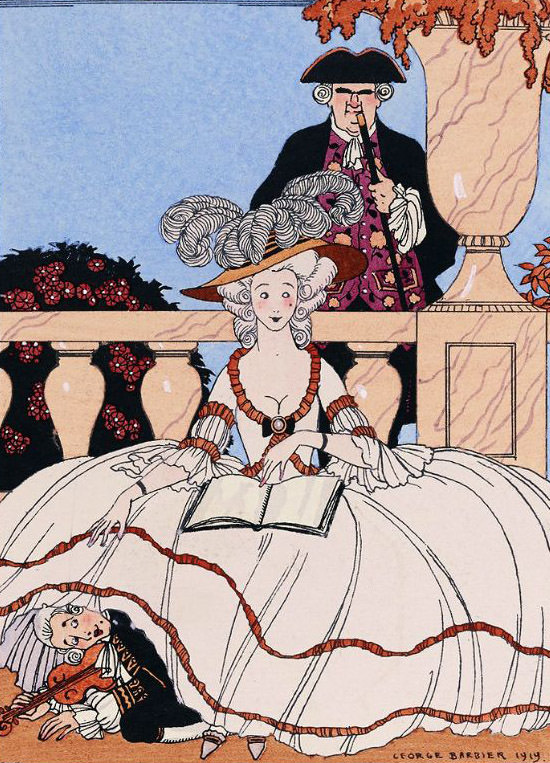
Silken excess and playful restraint meet on a terrace scene that feels lifted from an operetta: a young woman in a sweeping white dress sits poised with an open book on her lap, her powdered curls and broad hat edged with extravagant feathers. Behind her, a sternly dressed gentleman stands like a watchful tutor, while a small doll sprawls at the hem of the gown, echoing the theme of “the lesson well learned” with a wink. Decorative balustrades, stylized foliage, and a cool, uncluttered sky frame the figures in a way that emphasizes fashion, posture, and performance over realism.
Published under the title “La leçon bien apprise” in La Guirlande, November 1919, the artwork belongs to the era’s taste for elegant line, ornamental pattern, and theatrical character types. The palette—soft blues, creamy whites, and warm accents—highlights textures and trims, from ribboned bodice details to the crisp geometry of the terrace architecture. Every element feels curated, turning a quiet moment of reading into a staged tableau of etiquette, instruction, and social display.
For readers interested in French illustration and early twentieth-century print culture, this piece offers a vivid glimpse of postwar refinement expressed through costume and design. It’s an image that rewards slow looking: the contrast between authority and leisure, the doll’s comic undercutting of seriousness, and the way the composition guides the eye from book to gaze to the supervising figure. As a historical artwork from 1919, it also serves as a charming example of how magazines and portfolios used fashion-inflected imagery to tell stories without needing a single spoken line.