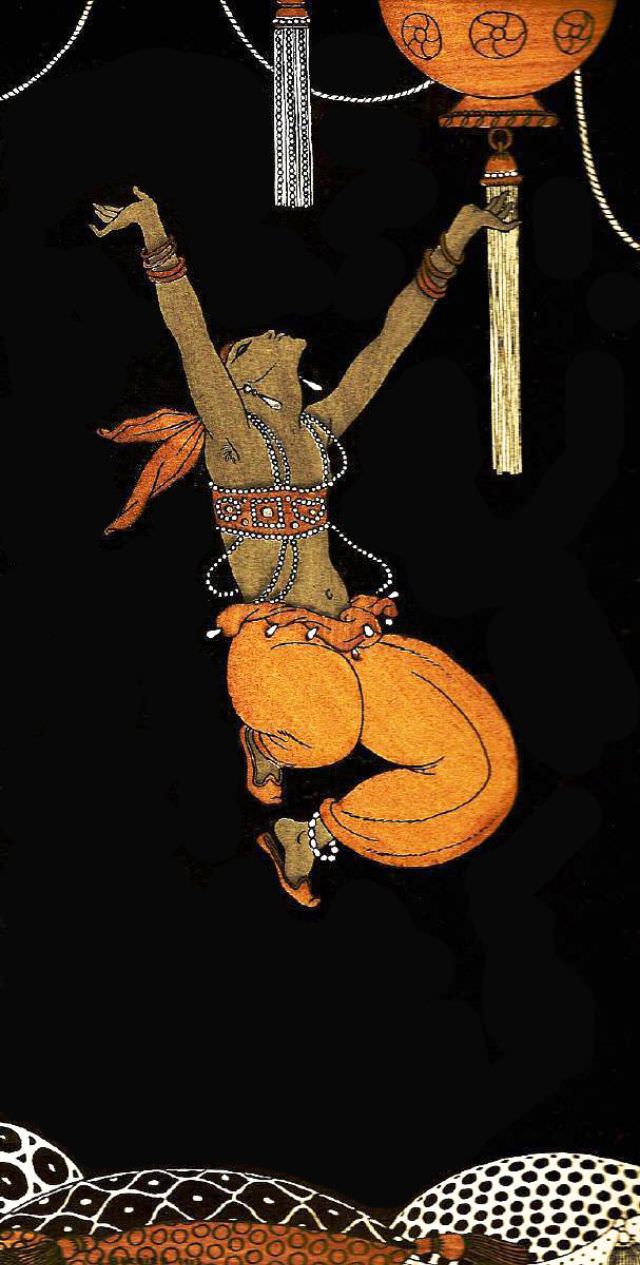
Few stage images feel as charged as Vaslav Nijinsky suspended in midair, his body curled and buoyant as if the theatre’s gravity has briefly been rewritten. The dark background sharpens the silhouette, while warm oranges and precise lines pull the eye to the costume’s folds and the dancer’s lifted arms. Even in a single frame, the pose suggests the daring physicality that made Nijinsky’s performances legendary.
Schéhérazade, as staged in Paris around 1910, belonged to the era when Ballets Russes spectacle met modern design, and the visual world mattered as much as the choreography. Here, decorative motifs and hanging elements frame the figure like a patterned proscenium, reinforcing the production’s exotic, storybook atmosphere without needing elaborate scenery. The costume’s jeweled details and bold color accents read like a collaboration between dance and graphic art, capturing how early twentieth-century ballet was photographed, collected, and remembered.
Collectors and dance historians often return to images like this for what they preserve: a fleeting moment of movement made permanent, and a window into Parisian cultural life on the eve of profound change. For readers searching for Vaslav Nijinsky in Schéhérazade, Ballets Russes history, or early ballet performance photography, this post offers a vivid reference point—part document, part icon. It is an artwork of performance memory, where gesture, costume, and staging meet to tell the story.