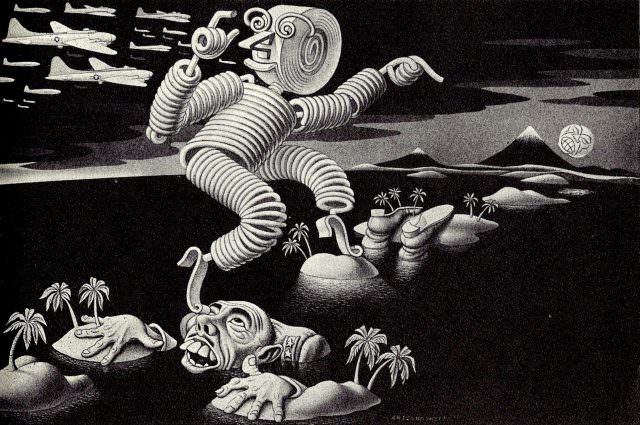
Surreal menace and satirical wit collide in Boris Artzybasheff’s WWII-era anti-Nazi illustration, where a spring-coiled, mechanical figure lurches across a barren landscape like a weapon given legs. The exaggerated anatomy—ribbed tubes, oversized hands, and a masklike head—turns the character into a caricature of militarized force, more machine than human. Overhead, aircraft streak across the darkness, sharpening the sense of invasion and relentless motion.
Down below, a grotesque face emerges from the ground, mouth open in a silent howl as the mechanical intruder strides past scattered palms and jagged outcrops. The composition reads like a nightmare staged in broad, graphic contrasts: bright whites slicing through deep blacks, with hard edges and simplified forms that feel both modernist and eerily theatrical. Artzybasheff’s visual language makes propaganda personal—war becomes not only armies and hardware, but a symbolic struggle against dehumanization.
Readers searching for Boris Artzybasheff anti-Nazi illustrations, WWII political cartoons, and wartime propaganda art will recognize how creativity becomes a weapon in itself here. Rather than relying on literal scenes of battle, the artwork attacks ideology through metaphor, exaggeration, and dark humor, transforming tyranny into something absurd and monstrous. It’s a striking reminder that during World War II, artists could confront fascism not just with facts, but with unforgettable images designed to stick in the mind.