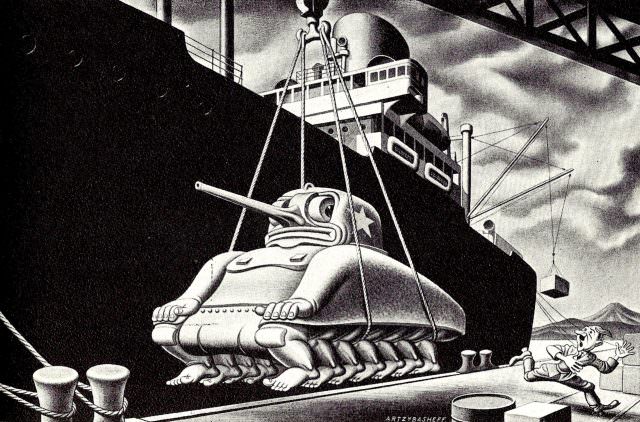
Boris Artzybasheff’s wartime imagination turns military hardware into something grotesquely alive, and the effect is instantly unsettling. A bulbous, turtle-like tank with a glaring “eye” and a star emblem seems to crawl forward on a tangle of legs, its metal body rendered with smooth highlights that make it feel both cartoonish and menacing. Looming behind it, the dark mass of a ship’s hull and deck structures suggests a port or dockside setting, framing the creature as cargo from an industrial war machine.
The illustration thrives on contrast: heavy shadows and sharp whites, rigid steel geometry and absurd, almost biological motion. Artzybasheff’s linework gives the tank a sinister personality—part weapon, part monster—while cables, bollards, and maritime details ground the satire in a believable wartime world of transport and logistics. Off to the right, a small human figure appears dwarfed and endangered, emphasizing how propaganda art often translated geopolitical dread into visual allegory.
Viewed today, these anti-Nazi illustrations read as both creative resistance and psychological warfare on paper, using exaggeration to strip fascist power of dignity. The image also highlights why WWII political cartoons and graphic art remain so searchable and discussable: they compress fear, anger, and moral judgment into a single scene that’s easy to grasp and hard to forget. For readers exploring Artzybasheff’s WWII artworks, this piece offers a vivid example of how surrealism and satire helped shape the era’s visual language of opposition.