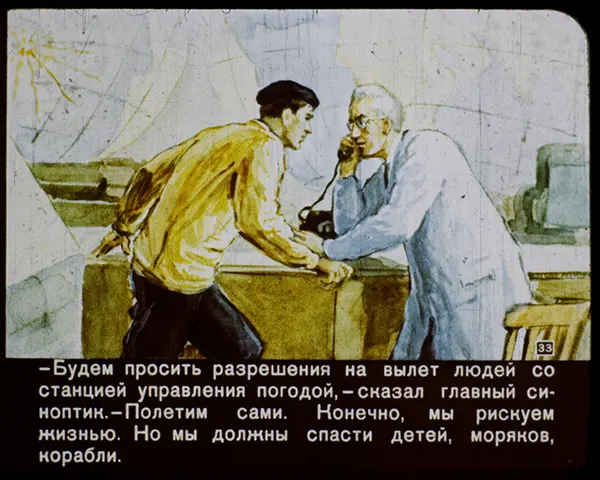
Urgency hangs over the scene as two men lean in across a desk, their bodies angled toward a decision that cannot wait. One figure grips the tabletop as if steadying himself, while the other—older, bespectacled, and composed—listens with the weight of responsibility on his shoulders. The washed, hand-tinted colors and sketched interior details give the work the feel of an illustrated still, poised between documentary realism and dramatic storytelling.
The title’s dialogue about asking permission to evacuate people from a “weather control station” frames the image as a moment of high-stakes planning, where meteorology becomes a matter of life and death. Even without a specific place or date, the composition evokes an era when command desks, telephones, and institutional rooms symbolized both authority and vulnerability. The Russian caption at the bottom reinforces the sense of a scripted narrative—part public message, part moral appeal—focused on saving children, sailors, and ships.
Seen today, the piece works as a historical artwork that borrows the language of emergency management and heroic duty to create tension and empathy. It invites readers to consider how societies have imagined science, aviation, and bureaucratic permission as tools of rescue in the face of disasters at sea. For collectors, researchers, and WordPress readers interested in Soviet-era illustration, propaganda aesthetics, or the cultural history of weather and risk, this image offers a vivid entry point into a world where forecasts and courage were inseparable.