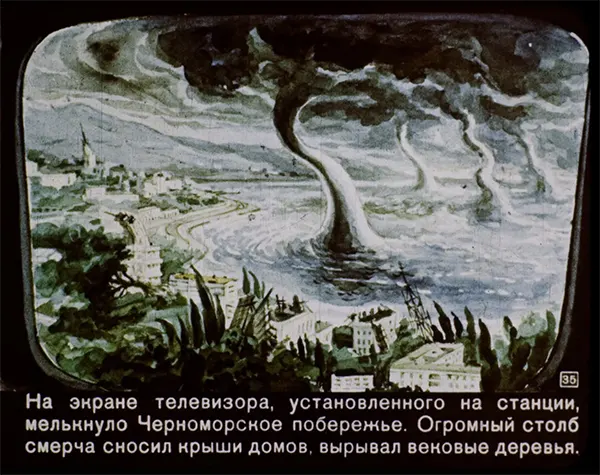
Across the curved glow of a station television screen, the Black Sea coast appears in a sudden, unsettling broadcast—more like a warning than a program. A towering tornado funnels down from bruised clouds, its dark column cutting through the shoreline scene with a force that feels immediate even at a distance. The composition leans into urgency: a restless sky, churning water, and the thin line between everyday life and catastrophe.
Along the coast, rooftops and trees seem to be torn into the air as the storm bears down on clustered buildings, suggesting a long-established village being unmade in minutes. The artwork’s sweeping brushwork and high contrast turn wind into something visible—curling, grabbing, and dragging the landscape toward the vortex. Details like the waterfront curve and scattered structures help anchor the drama, making the destruction feel both expansive and intimately local.
Beneath the image, Cyrillic text reinforces the idea of a fleeting on-screen report, adding a layer of media history to the disaster narrative. For a WordPress post exploring historical coastal storms, Black Sea imagery, or the way television once delivered breaking news to public spaces, this piece offers a vivid entry point. It also reads as a reflection on memory: how a single televised flash can preserve the terror, scale, and aftermath of a tornado long after the screen goes dark.