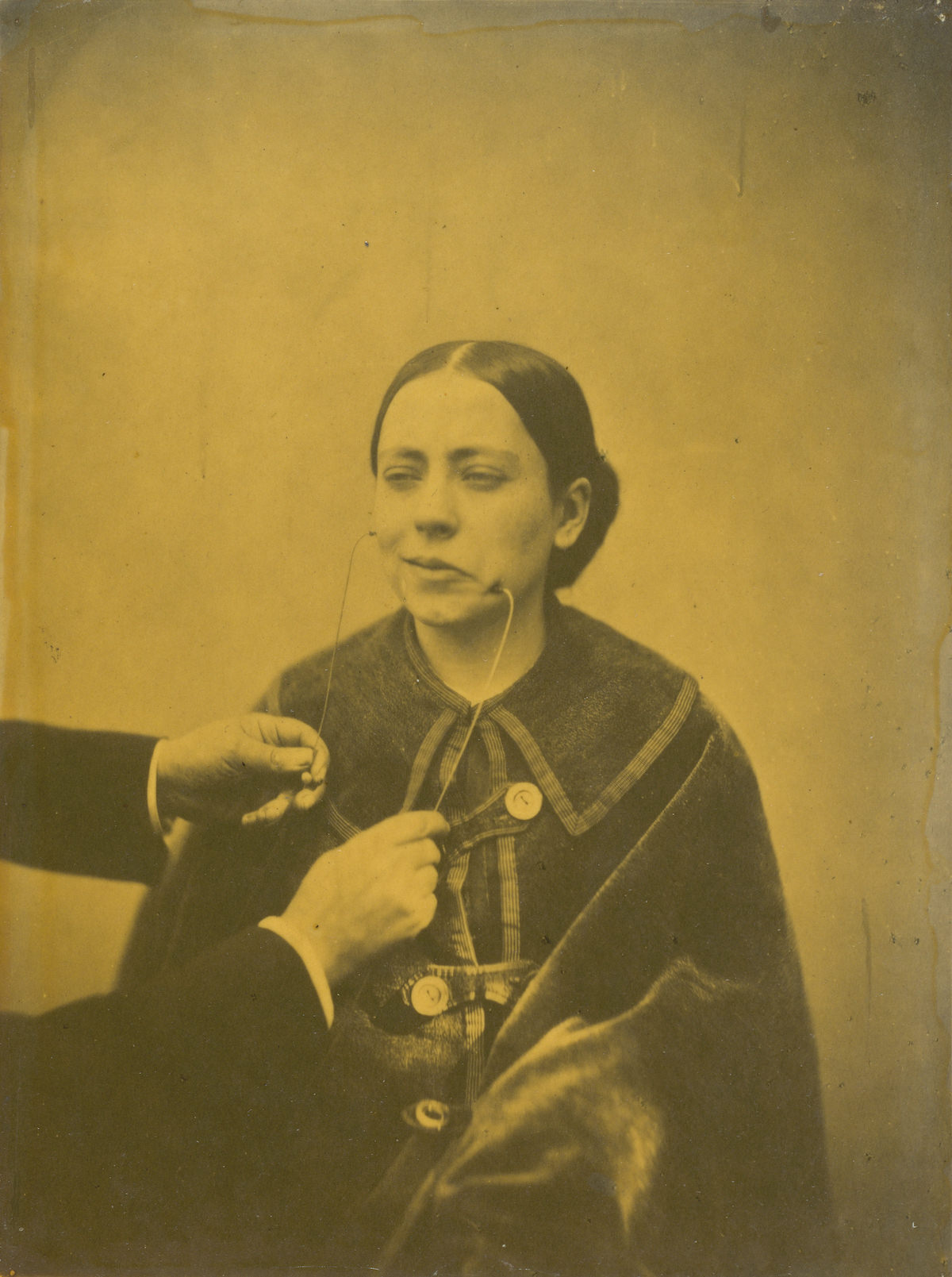
A young woman sits against a plain studio backdrop, her hair parted and smoothed back, her expression hovering between composure and strain. The title, “Figure 50: Affected weeping and face in repose,” points the viewer toward the smallest signals—tightened lips, softened eyelids, the slight slackening that follows an attempted show of emotion. Even the warm, aged tonality of the print lends the scene a hushed intimacy, as if we’re watching a private feeling being arranged for the lens.
From the left edge, an unseen assistant’s hands enter the frame holding thin wires or cords near the sitter’s face, suggesting a guided demonstration rather than a spontaneous portrait. That intervention makes the photograph read like an instructional plate: emotion as something that can be posed, tested, or categorized, with the “weeping” face contrasted against a neutral “repose.” The woman’s heavy, buttoned garment and the careful, controlled setup reinforce the sense of an artwork made for study—part performance, part record.
Viewed today, this historical image invites questions about how earlier generations tried to translate inner life into visible, teachable forms. It belongs to a visual tradition that bridges art, early psychology, and photographic practice, using the camera to fix fleeting expressions into evidence. For readers interested in vintage portraiture, the history of emotion in art, or archival studies of facial expression, Figure 50 offers a compelling glimpse into the craft of making feeling legible.