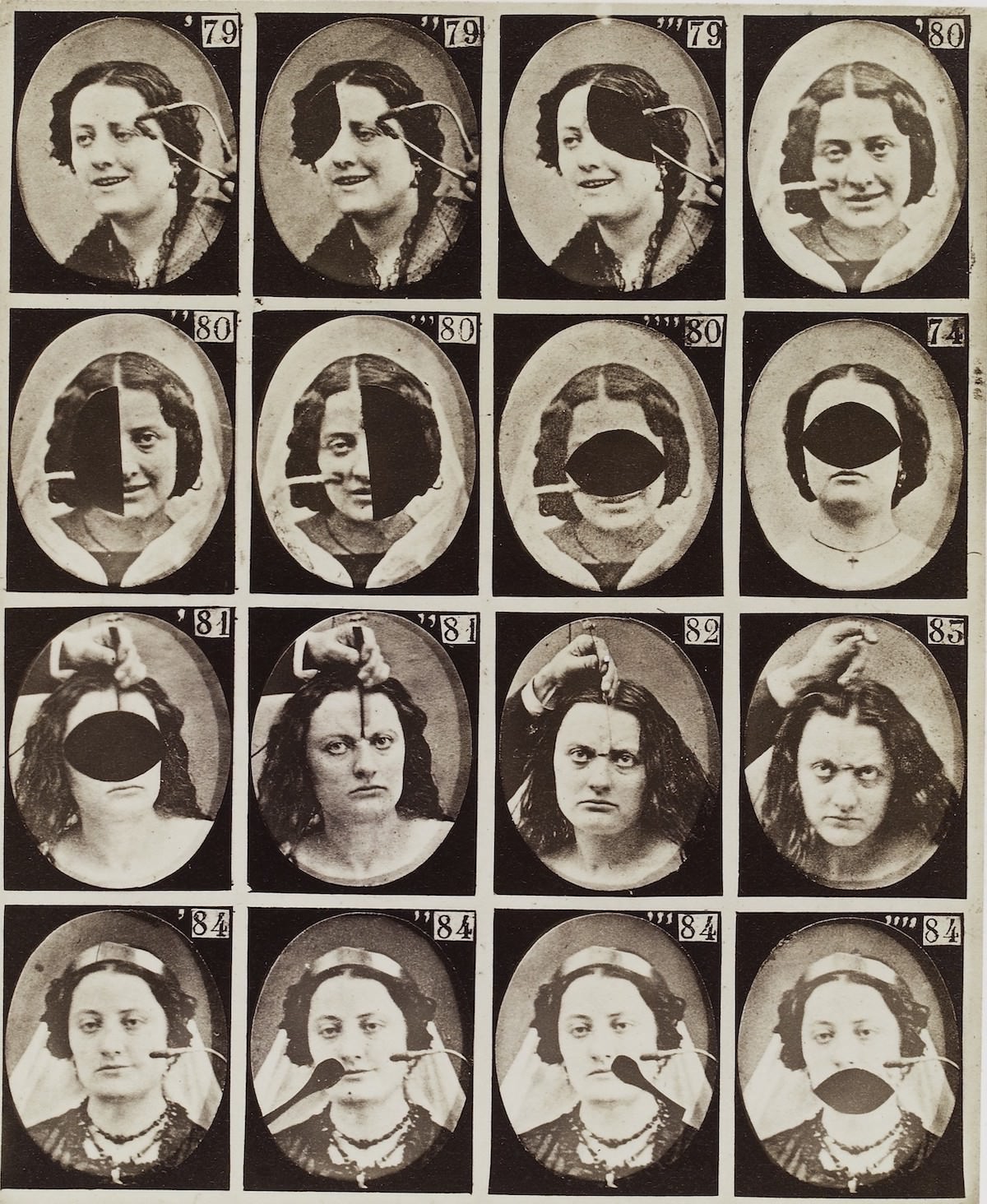
Across a grid of oval portraits, a single sitter is presented again and again, each frame labeled with small numbers that read like specimen tags. Dark masks, cutout shapes, and probing instruments partially cover the face, turning ordinary features into a controlled study of expression. The repetition is mesmerizing: a slight smile here, a tightened brow there, all arranged with the severity of a scientific plate and the intimacy of a studio portrait.
Guillaume-Benjamin-Amand Duchenne de Boulogne’s “Mechanism of Human Physiognomy” sits at the crossroads of art history, early neuroscience, and the birth of photographic documentation. These illustrations echo the 19th-century desire to map emotions onto muscles, using apparatus and staging to isolate what the eye might otherwise miss. For modern viewers, the result feels both clinical and strangely theatrical, revealing how photography was enlisted to argue that feelings could be measured, demonstrated, and cataloged.
Collectors of medical history imagery, vintage anatomy prints, and physiognomy studies will find plenty to linger over in the fine contrasts and meticulously repeated poses. The page reads like a storyboard of the human face under experiment—an SEO-friendly treasure for anyone researching Duchenne de Boulogne, historical facial expression research, or early scientific photography. Even without a specific date or place printed on the plate, the visual language speaks clearly: this is a landmark moment when illustration, observation, and the camera were fused to chase the mechanics behind emotion.