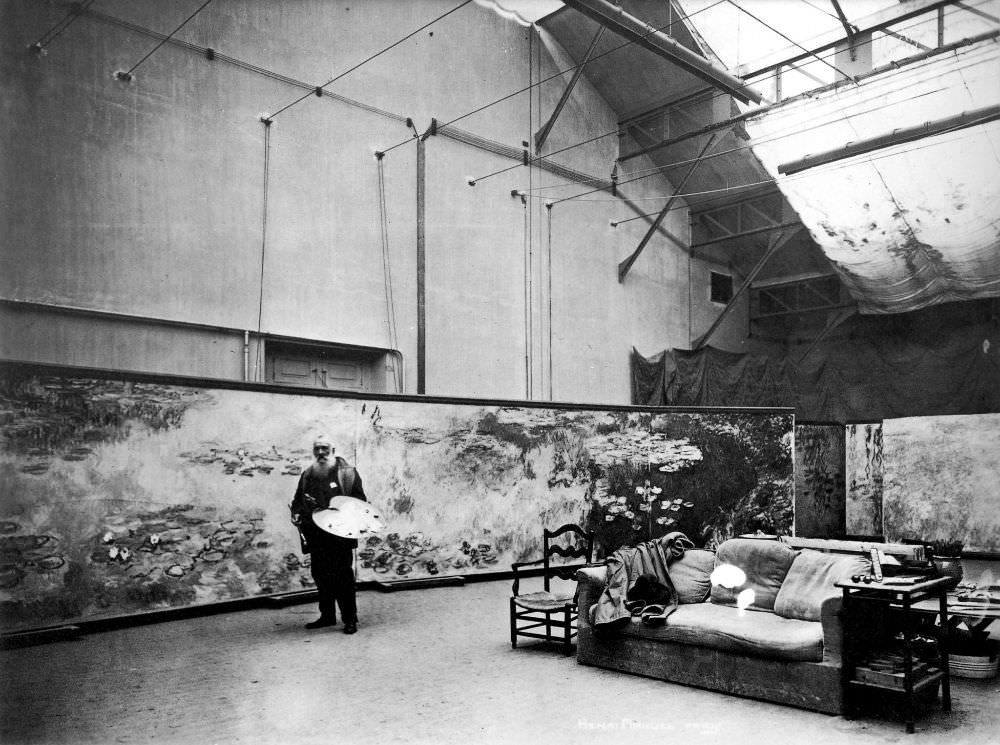
Inside a vast, skylit studio, Claude Monet stands before an immense canvas that stretches like a horizon across the wall, his palette in hand and his world of water and foliage rising at life-size scale. Overhead, a lattice of beams, cords, and diffused glass suggests a space engineered for light—controlled, softened, and made steady enough for the patient work of revisiting the same motif again and again. The room feels both workshop and sanctuary, with the sheer breadth of the painting hinting at the ambition behind Monet’s garden-inspired series.
Along the studio’s edges, everyday comforts intrude on the grandeur: a sofa and chairs, a table cluttered with practical objects, and additional canvases leaning in quiet readiness. That domestic note matters, because it echoes the intimacy of Giverny itself—an environment cultivated not only as a garden, but as a living laboratory for color, reflection, and atmosphere. The lily pads and rippling surface suggested across the canvas connect this interior to the outdoor “personal eden” that fed Monet’s imagination and sustained his lifelong experimentation.
Giverny was more than a picturesque backdrop; it was a deliberate artistic project, shaped and reshaped to provide subjects that changed with season, weather, and hour. In this historical photograph, the scale of the studio and the immersive paintings reveal how Monet translated garden observations into enveloping artworks, where viewers are invited to step into light and water rather than simply look at them. For anyone searching Claude Monet studio, Giverny gardens, or Water Lilies artworks, this glimpse behind the scenes offers a rare sense of how place, process, and painterly vision merged into one enduring legacy.